
What the Khanjar means in Omani culture, beyond the blade
Quick answer: In Omani culture, the Khanjar, a curved dagger worn at the waist with traditional dress, stands for heritage, identity and belonging rather than as a weapon. Men wear it at weddings, national holidays and formal gatherings to signal dignity and respect for custom. Some khanjars pass between generations, and the dagger sits at the center of Oman's national emblem.
The Khanjar is a curved dagger worn at the waist with traditional Omani dress, and in Oman its meaning is best read as heritage and identity rather than as a weapon. Men wear it at weddings and national celebrations, where it signals belonging, dignity and respect for custom. The dagger also appears on Oman's national emblem, a sign of how closely it is tied to the country's identity.
By the end of this guide on the Khanjar, you will be able to explain what the dagger stands for in Omani life without reducing it to a blade. You will learn how it is worn, when it appears, and why its shape carries meaning on its own. That knowledge also helps you read Khanjar imagery in art or design with respect and a clearer eye.
Key facts
- In many Omani families, a boy starts wearing a Khanjar as he nears manhood, signaling that more is expected of him.
- Some khanjars are handed down through generations, linking a man to the relatives who wore them before him.
- Silversmiths decorate Khanjar sheaths and hilts with metalwork that varies by region, so an expert may tell where one comes from.
- Omani men wear the Khanjar to show identity and belonging, and its blade almost never leaves the sheath.
- Most Omani men no longer wear the Khanjar daily, saving it for weddings, national holidays, official ceremonies and gatherings with elders.
- The Khanjar sits at the center of Oman's national emblem and appears on the national flag.
What does the Khanjar mean in Omani culture?
The blade sits inside a sheath whose sharp upward bend gives the Khanjar its familiar outline. The blade usually stays sheathed, so what you notice is the hilt, the sheath and the care that went into making them. That visible craftsmanship is where most of the meaning lives.
The Khanjar marks a stage of life as much as a style of dress. In many Omani families, a boy begins wearing one as he grows toward manhood, and the change signals that more is now expected of him. Some khanjars pass from one generation to the next, so a single piece can tie a man to the relatives who wore it before him. Owning and wearing one becomes a quiet statement about family and continuity.

The Khanjar also speaks for Oman as a whole. Silversmiths decorate sheaths and hilts with detailed metalwork, and styles can vary from one region to another, so a trained eye may read where a piece comes from. A man wearing one shows that he belongs to a place and a shared history he is proud to carry. For you as an outside observer, the closest comparison is a formal tie or a family crest, worn to honor something larger than the wearer, rather than a weapon kept ready for use.
How is the Khanjar worn with traditional Omani dress?
An Omani man wears the Khanjar at the center front of his waist, held by a belt fastened over his long robe. The robe is the dishdasha, a collarless garment that usually reaches the ankles and is most often white. The belt may be leather, woven cloth or silver-worked, and the sheath hangs from it before its tip bends sharply upward. Because of that placement, the Khanjar is often the first thing you notice on a formally dressed Omani man.
The Khanjar belongs to a complete outfit rather than serving as an accessory added at random. Most men pair the robe and dagger with a head covering, either the embroidered cap called a kumma or a wrapped turban known as a massar. For the most formal moments, a light cloak edged with gold or silver thread may go over everything, with the dagger still showing at the front. Wearing it at the center keeps the hilt and metalwork in plain view.
The Khanjar is no longer part of everyday dress for most Omani men, so each appearance carries weight. You are likely to see it at weddings, where the groom and his male relatives often bring out their finest pieces, and at national holidays and official ceremonies. Men may also wear one when receiving honored guests or attending formal gatherings with community elders. In every one of these settings, the dagger signals that the occasion deserves respect and careful dress.
Why is the Khanjar a mark of identity rather than a weapon?
The Khanjar is a mark of identity because Omani men wear it to show who they are and where they belong, not to fight anyone. At the occasions where it appears, the blade almost never leaves its sheath. What people notice and judge instead is the silverwork, the shape of the hilt and how well the piece suits the man wearing it.
The Khanjar's design makes the same argument. A man who carried a dagger only for defense would want it plain, light and quick to draw. Instead, makers pour long hours into ornamenting a sheath that no fighter would need, and that effort only makes sense if the object is meant to be seen. Value that rests on decoration rather than on a sharp edge belongs to the world of dress.
The Khanjar has a familiar parallel in North America: the dress sword that military officers carry at formal parades and weddings. Nobody watching a row of raised swords over a newly married couple thinks about combat. The sword stands for service, rank and the institution behind the person holding it. The Khanjar works in a similar way, speaking for a family, a region and a country.
The Khanjar also earns its meaning through the people around it. Worn in front of relatives, guests and elders, it tells the community that its wearer accepts his place among them and the duties that come with it. Reading the Khanjar as a weapon misses that social role, which is where its real weight lies.
Where does the Khanjar appear beyond the belt?
The Khanjar sits at the center of Oman's national emblem, appears on the national flag, and turns up across the country's money, official seals and everyday design. Oman's emblem shows the curved dagger in its sheath, fastened to an ornate belt and laid over two crossed swords. Placing the Khanjar in front of the swords gives the dress dagger the place of honor.
Oman's flag carries that same emblem in the upper corner near the pole, set against a red band beside fields of white and green. Every time the flag is raised at a school, a ministry or a sports match, the Khanjar goes up with it. You could compare its role to the eagle on official American seals, a single image that stands for the whole country.
The Khanjar's outline also travels well beyond state symbols. The emblem shows up on banknotes, passports and government buildings. Craftsmen and designers borrow the dagger's curved shape for jewelry, souvenirs, logos and decorative work, so the form stays familiar even in a shop window.
That wide reach means an Omani man who rarely wears a Khanjar still sees one almost daily. The object has moved from the belt to the flag, the wallet and the street, and it carries the same message of belonging wherever it lands.
How can a watch dial carry the Khanjar and Eastern Arabic numerals?
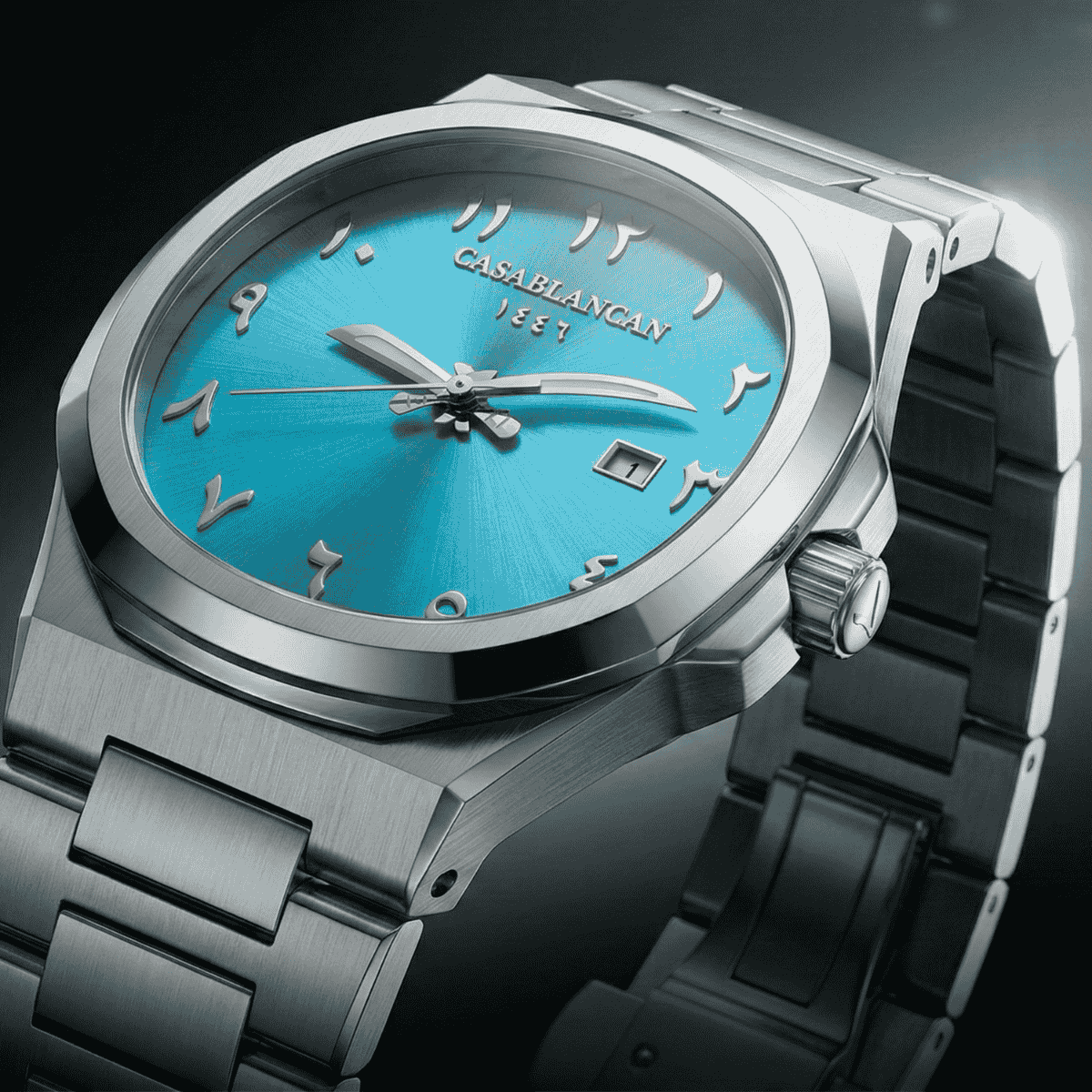
The Casablancan dial shapes its hour and minute hands like the Khanjar and sets an Eastern Arabic numeral at every hour, so the dagger travels around a full ring of Arabic digits. The same curved form you would see on an Omani belt or on the national emblem becomes the part of the watch you read most often. Each time you check the hour, the two Khanjar hands point the way.
Eastern Arabic numerals run around the Casablancan dial from ١ at one o'clock to ١٢ at the top, with no hour left blank. These are the digits many people across the Arab world, including Oman, use for everyday counting on signs, receipts and phones. Pairing them with the Khanjar keeps the whole face in one visual language.
The sunray finish on the Casablancan dial comes in green, black, brown or turquoise. Fine lines radiate from the center and catch light as your wrist moves. The turquoise version, Al Majaz, sits in a 43mm, 11mm-thick case of 304 stainless steel under sapphire crystal, driven by a quartz movement. A matching steel bracelet arrives with an adjustment tool, and the 3 ATM rating covers handwashing, light rain and splashes, so take it off before swimming or showering.
Reading the Casablancan dial gets easier once you anchor on four positions: ١٢ at the top, ٣ on the right, ٦ at the bottom and ٩ on the left. Watch for ٥, which looks like a small circle and is easy to mistake for a zero. The Eastern Arabic zero is actually ٠, a small dot, and on this dial it appears only inside ١٠.

The Al Majaz is our own watch at Casablancan, and its hour and minute hands take the shape of the Khanjar dagger. On the dial, the dagger works as a marker of identity, pointing to Eastern Arabic numerals at every hour on a turquoise sunray face. The 43mm, 11mm-thick case is 304 stainless steel with sapphire crystal and a quartz movement. The Al Majaz is $89.
Frequently asked questions
What is the dishdasha worn with the Khanjar?
The dishdasha is a collarless Omani robe that usually reaches the ankles and is most often white. Omani men fasten a belt over the dishdasha and wear the Khanjar at the center front of the waist.
When do Omani men wear the Khanjar today?
The Khanjar is no longer everyday dress for most Omani men. Men wear the Khanjar at weddings, national holidays and official ceremonies. Men also wear it when receiving honored guests or attending formal gatherings with community elders.
What does it mean when an Omani boy starts wearing a Khanjar?
In many Omani families, a boy begins wearing a Khanjar as he grows toward manhood. The change signals that more is now expected of him. Some khanjars pass down through generations, linking a man to the relatives who wore them before.
Is the Khanjar on Oman's flag?
Oman's flag carries the national emblem in the upper corner near the pole, set against a red band beside fields of white and green. The emblem shows the sheathed Khanjar on an ornate belt, laid over two crossed swords.
What head covering goes with the Khanjar in Omani dress?
Omani men usually pair the robe and Khanjar with an embroidered cap called a kumma or a wrapped turban known as a massar. For the most formal moments, a light cloak edged with gold or silver thread may go over everything.
Casablancan makes the Al Majaz mentioned in this article.
Read more
Awake added four gradient Silver Leaf Vignette dials to its Sơn Mài Collection, Fratello reported on 2026-11-09. Made with Vietnamese lacquer and pure silver leaf in a 38 mm case, each costs €2,640...
A. Lange & Söhne's Saxonia Annual Calendar in 18K white gold fits a full annual calendar into a 36mm case that is 9.8mm thick. It debuted at Watches and Wonders in 2026 and uses the new automat...