

Why watch hands are shaped like a Khanjar dagger
Quick answer: Watch hands are shaped like a Khanjar because the curved dagger's outline makes the time easy to read at a glance. The blade is broad near the center and narrows to a sharp tip, so the point marks the exact hour without covering the numeral. The wider body keeps the hand visible, even on a shimmering sunray dial.
Watch hands shaped like a Khanjar borrow the outline of a curved dagger, and the shape is a practical choice for reading the time at a glance. A Khanjar narrows from a broad body to a sharp tip, so the point shows clearly which hour a hand is aiming at. That pairs well with Eastern Arabic numerals, where each hour is a distinct shape you match quickly.
A dial with Khanjar hands and Eastern Arabic numerals is easier to learn than it first looks. After reading, you will be able to name every hour from ١ to ١٢ and spot the two shapes that most often trip people up. You will also be able to judge whether the dagger shape suits the way you glance at your wrist.
Key facts
- A Khanjar hand copies the dagger's curved blade, which is broad near the hilt and tapers to a sharp point.
- A blade fits a watch hand because both must point precisely at one spot while staying easy to see.
- The fine tip lands on the hour position, so it is clear which numeral the hand indicates.
- The wider base keeps the hand visible on a shimmering sunray dial that brightens and darkens as the wrist tilts.
- A pointed tip marks compact Eastern Arabic numerals like ٧ or ٨ without covering them, unlike a blunt paddle hand.
- When both hands share the dagger shape, the shorter one shows the hour and the longer one shows the minutes.
Why are watch hands shaped like a Khanjar?
A Khanjar hand borrows the dagger's curved, tapering blade, which ends in a sharp point and gives the hand a clear outline your eye picks out quickly against the numerals. A blade suits a watch hand because both have the same job: pointing precisely at one spot while staying easy to see.
The Khanjar blade is broad near the hilt and narrows steadily toward its tip, usually with a pronounced curve. On a dial, that taper puts visual weight near the center and leaves a fine point at the outer end. The point lands on the hour position, so you are not left guessing which numeral the hand means. The wider base keeps the hand from fading into the background, even on a dial with a shimmering finish.

Eastern Arabic numerals make a precise tip especially useful, because many of the digits are compact, angular shapes rather than wide, rounded figures. A blunt or paddle-shaped hand can cover part of a numeral like ٧ or ٨ and make you look twice. A dagger tip indicates the hour without hiding it, which matters on a dial that carries a numeral at every position.
The Khanjar outline also gives the hands a regional identity that a plain stick or sword hand lacks. For you, the practical payoff is a hand you can recognize by its shape alone, even when you only catch the dial for a second.
What makes a dagger-shaped hand easier to read at a glance?
A dagger-shaped hand reads quickly because its sharp tip marks one exact spot, its wide body holds its outline, and its length tells you which hand you are seeing. Each of those cues does its own job when you glance at your wrist. Together they cut down the moments where you squint or look a second time.
| Eastern Arabic | Western | How to spot it |
|---|---|---|
| ٠ | 0 | A small dot, not a circle |
| ١ | 1 | One upright stroke, like a Western 1 |
| ٢ | 2 | An upright stroke with one hook at the top |
| ٣ | 3 | An upright stroke with two hooks at the top |
| ٤ | 4 | Looks like a backward 3 |
| ٥ | 5 | A small circle, the one people mistake for zero |
| ٦ | 6 | A short top stroke and a straight drop, close to a 7 |
| ٧ | 7 | A V that opens upward |
| ٨ | 8 | An upside-down V |
| ٩ | 9 | Close to a Western 9 |
| ١٠ ١١ ١٢ | 10 11 12 | Two digits, read left to right like Western numbers |
The tapered tip of a Khanjar hand helps most when the time falls between two numerals. A fine point lets you judge how far the hand has traveled from ٣ toward ٤, for example, instead of guessing from a broad shape. On the minute hand, that same precision turns a quick look into a usable reading, such as a tip resting on ٦ for half past.
A sunray dial adds a challenge that the broad body of the hand is built to handle. The brushed finish radiates from the center, so the dial brightens and darkens as you tilt your wrist. A thin stick hand can flash out of sight in that shimmer, while a wider blade keeps a solid silhouette on green, black, brown or turquoise.
Hand length is the cue that separates hour from minute when both hands share the dagger shape. On a typical watch, the hour hand is the shorter one and stops near the numerals, while the minute hand reaches farther out. Find the shorter blade first and read its hour, then let the longer one fill in the minutes.
How do you read Eastern Arabic numerals on a watch dial?
Eastern Arabic numerals read like familiar digits once you pair each symbol with its value, from ١ at one o'clock around to ١٢ at the top. A dial marked this way keeps the same clockwise order as any Western watch, so only the shapes change, not their positions. Moving down the right side, ١ is 1, ٢ is 2, ٣ is 3, ٤ is 4, ٥ is 5 and ٦ is 6 at the bottom.
The left half of an Eastern Arabic dial continues upward with ٧ for 7, ٨ for 8 and ٩ for 9. The two-digit hours are written left to right, just as Western numbers are, so ١٠ pairs a one with ٠, the zero, to make 10. Next come ١١ for 11 and ١٢ for 12, closing the circle at the top. Because ٠ is only a small dot, ١٠ can look like a single stroke with a speck beside it.
The four quarter positions are the quickest anchor while you learn Eastern Arabic shapes. The numerals ٣, ٦, ٩ and ١٢ sit at 3, 6, 9 and 12, so memorizing those four gives you a frame for the rest. From any quarter, count one step forward or back to name the hour beside it, as you would on a dial with plain markers. After a few days of glancing at your wrist, you may find yourself reading ٤ or ٨ as a number rather than a symbol to decode.
A full reading on an Eastern Arabic dial combines both hands in the usual way. Each numeral also stands for five minutes, so a longer hand resting on ٤ means twenty past the hour.
Which Eastern Arabic numerals are easiest to mix up?
The shapes that trip up new readers most often are ٥, which looks like a Latin zero but means 5, and the mirrored pair ٧ and ٨. The numeral ٥ sits at the five o'clock position, and its rounded loop invites a Western eye to read it as nothing at all.
The numerals ٧ and ٨ form the second tricky pair, because each is the other turned over. ٧ opens upward like a V, while ٨ opens downward like a peaked roof. One easy memory hook is to picture ٧ as a cup that holds water and ٨ as the same cup tipped over. Mixing them up costs you an hour on the shorter hand, or five minutes on the longer one.
Dial position is the quickest way to settle any doubt about these shapes. The round ٥ sits one step before ٦ at the bottom, so its place confirms its value even when the loop looks like zero. Moving up the left side from ٦, the upward-opening ٧ comes first, with the downward-opening ٨ just above it.
How Khanjar hands and Eastern Arabic numerals share one dial
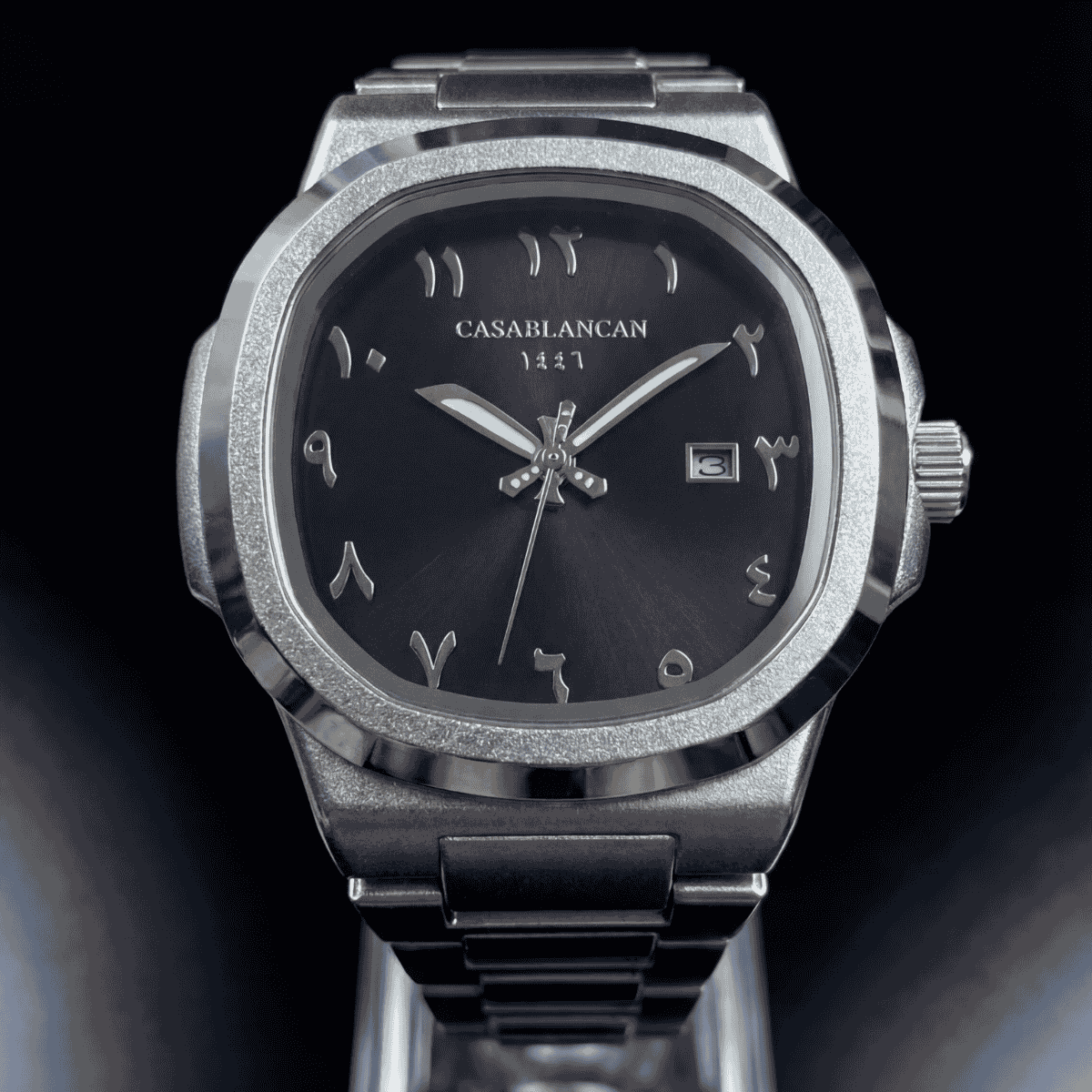
Eastern Arabic numerals fill all twelve positions, with no plain markers or Western digits mixed in. Both the hour hand and the minute hand take the outline of the Khanjar dagger. Your eye follows a blade and stops on a number, which is the whole idea of the pairing.
A sunray finish sits behind those hands, in green, black, brown or turquoise. A hand with a distinct dagger outline stays easy to pick out against that shifting background. The sapphire crystal above it is a hard material that resists the fine scratches that can cloud a dial over time.
The Casablancan case measures 43mm across and 11mm thick, made from 304 stainless steel. That width leaves room around the edge for twelve numerals, including the two-digit ١٠, ١١ and ١٢ at the top. A quartz movement drives the hands, so the watch keeps running without winding.
A Khanjar hand gives you the most help when you read it from the point rather than the base. Ignore the end near the center, follow the shorter blade out to its tip, and name the numeral it touches or has just passed. Then do the same with the longer blade for the minutes, and you have the time.

The Green Sunray Khanjar is our own watch, built around this pairing on a forest green sunray dial. Its hour and minute hands take the Khanjar dagger shape, pointing toward Eastern Arabic numerals marked at every hour. The 43mm, 11mm-thick 304 stainless steel case holds sapphire crystal and a quartz movement, on a matching steel bracelet. The watch costs $89 and is rated 3 ATM for handwashing and light rain, not for swimming or showering.
Frequently asked questions
How do you tell the hour hand from the minute hand when both are dagger-shaped?
On a watch where both hands share the Khanjar shape, length separates them. The hour hand is typically the shorter one and stops near the numerals, while the minute hand reaches farther out. Read the shorter blade's hour first, then let the longer one give the minutes.
Why do Khanjar hands stay visible on a sunray dial?
A sunray dial has a brushed finish radiating from the center, so it brightens and darkens as the wrist tilts. A thin stick hand can flash out of sight in that shimmer, while the broad body of a Khanjar hand keeps a solid silhouette.
What does the round numeral ٥ mean on a watch dial?
The Eastern Arabic numeral ٥ means 5 and sits at the five o'clock position. Its rounded loop often looks like a Western zero, but its place one step before ٦ at the bottom of the dial confirms its value.
How is 10 written in Eastern Arabic numerals?
Eastern Arabic numbers with two digits are written left to right, like Western numbers. The numeral ١٠ pairs a one with ٠, the zero, which is only a small dot, so ١٠ can look like a single stroke with a speck beside it.
Casablancan makes the Green Sunray Khanjar mentioned in this article.
Read more

Monochrome published a first look on 2026-11-06 at the Breguet Classique Souscription in 950 platinum, reference 2026PT/28/9W6. The 40mm single-hand watch matches the GPHG 2025 gold edition technic...
Awake added four gradient Silver Leaf Vignette dials to its Sơn Mài Collection, Fratello reported on 2026-11-09. Made with Vietnamese lacquer and pure silver leaf in a 38 mm case, each costs €2,640...