

So what does the Khanjar symbolize? it depends on who carries it
Quick answer: The Khanjar symbolizes honor, manhood and a readiness to protect family and guests rather than an eagerness to fight. Its details can signal family identity, region and social standing. At weddings it expresses pride and belonging, while on Oman's national emblem the same curved shape stands for the nation itself.
The Khanjar, the curved Arabian dagger a man wears at the front of his belt, changes meaning with who carries it and where. A Khanjar worn at a wedding shows respect for the occasion and pride in family standing, while the same curve on Oman's national emblem stands for the nation itself. This guide explains the dagger's roles first, then shows how a watch dial borrows its shape for the hands.
By the end of the Khanjar guide, you will know what the dagger means at a wedding, on a national emblem and on a man's belt. You will also be able to spot its curved silhouette in a pair of watch hands and read Eastern Arabic numerals at a glance. Then you can decide whether a dial carrying both details suits you.
Key facts
- Honor and manhood sit at the heart of what the Khanjar represents to the men who wear it.
- Kept in its sheath, the curved blade signals readiness to protect family and guests rather than eagerness to fight.
- The hilt material, the silver work on the sheath and the belt style can point to a region, tribe or family.
- Some khanjars are handed down from father to son, carrying the memory of the men who wore them earlier.
- On a national emblem, the curved Khanjar shape stands for a whole country rather than a single household.
- A young man putting on his first Khanjar marks a step toward adulthood and his place among family men.
What does the Khanjar symbolize?
A Khanjar in daily life works less like a weapon and more like a signature worn at the waist. A man who carries one is telling the people around him who he is and how he expects to be treated. That message is read at a glance, while the blade itself stays in its sheath.
Honor and manhood sit at the center of what the Khanjar means. The curved blade, kept sheathed, signals a readiness to protect family and guests rather than an eagerness to fight. Wearing the Khanjar is a statement of responsibility as much as of strength.

Family identity and social standing show up in the Khanjar's details. The hilt material, the silver work on the sheath and the style of the belt can hint at a region, a tribe or a particular family's taste. Some khanjars pass from father to son, so the dagger carries the memory of the men who wore it before. A finely worked Khanjar can signal means, while a plain one still makes the same claim to dignity.
The Khanjar's message also depends on the setting where you see it. At a wedding or a festival, the dagger reads as formal dress and pride in tradition. On a national emblem, the same curved shape speaks for a whole country rather than a single household. That flexibility is why one silhouette can carry personal, family and national meaning at the same time.
What does Khanjar mean in English, Arabic and urdu?
English usually keeps the original word rather than translating it, a quiet sign that "dagger" leaves something out.
A Khanjar in those languages can be almost any sharp knife, straight or curved, plain or decorated. In poetry and song, the word often becomes a figure for heartbreak, betrayal or a sudden wound. That figurative use shows how naturally the word moves from a tool to a feeling.
The Arabian Khanjar is a far more specific object than any dictionary entry suggests. The blade bends in a deep curve, and the sheath often sweeps upward into a sharp hook at its tip. A man wears it at the front of his belt, where everyone can see it, not tucked away at his side. Those details of shape and placement are what turn a common noun into a recognizable symbol.
The Khanjar you have read about so far lives in the space between the word and the thing. Translated, the word only names a blade. When you see the curved silhouette elsewhere, it is the fuller meaning that travels with it.
Who wears a Khanjar, and where does its meaning change?
In Oman, the dagger belongs to formal national dress, worn at the front of the waist over a long robe on official days, holidays and important visits. The same object can therefore read as ceremonial in one country and routine in the next.
A wedding gives the Khanjar a more personal message. The groom often wears a carefully chosen dagger, and male relatives and guests may wear theirs too, so a row of curved hilts shows two families coming together. In some communities, men hold or raise their daggers during traditional group dances, turning a blade into part of a shared rhythm. At these moments the Khanjar speaks of celebration and belonging rather than defense.
When men meet to settle a dispute, welcome a respected guest or mark a public occasion, the dagger shows respect for the setting and for everyone present. Leaving it at home would be a little like skipping a jacket and tie at a formal dinner in North America. In that room, the Khanjar works as a courtesy as much as a symbol.
The person wearing a Khanjar changes its meaning as much as the place does. A young man fastening on his first dagger marks a step toward adulthood and his place among the men of his family. An elder's well-worn Khanjar speaks of years of standing in the community, while an official's dagger at a state function represents the country itself.
How is the Khanjar different from the kirpan or the khanda?
The three words sound alike to an English speaker, and all three involve blades, so search results often blur them together. The resemblance mostly stops at the sound.
Sikh teaching connects the kirpan to a duty to protect the vulnerable and to resist injustice. Many wearers carry it on a cloth strap, often beneath their clothes, and treat it with reverence rather than as something to show off. That habit stands in clear contrast to the Khanjar's place at the front of the belt.
The design places a double-edged sword in the center, a circle around it, and two curved blades on either side. The word khanda also names the double-edged sword itself.
The Khanjar asks nothing of the wearer's faith. Its curve tells you about a place and a person, while the kirpan and khanda speak to a religious commitment that crosses borders. Keeping the three apart also shows respect, since a sacred article deserves different treatment than a piece of national dress.
How does a watch dial borrow the Khanjar's curve?
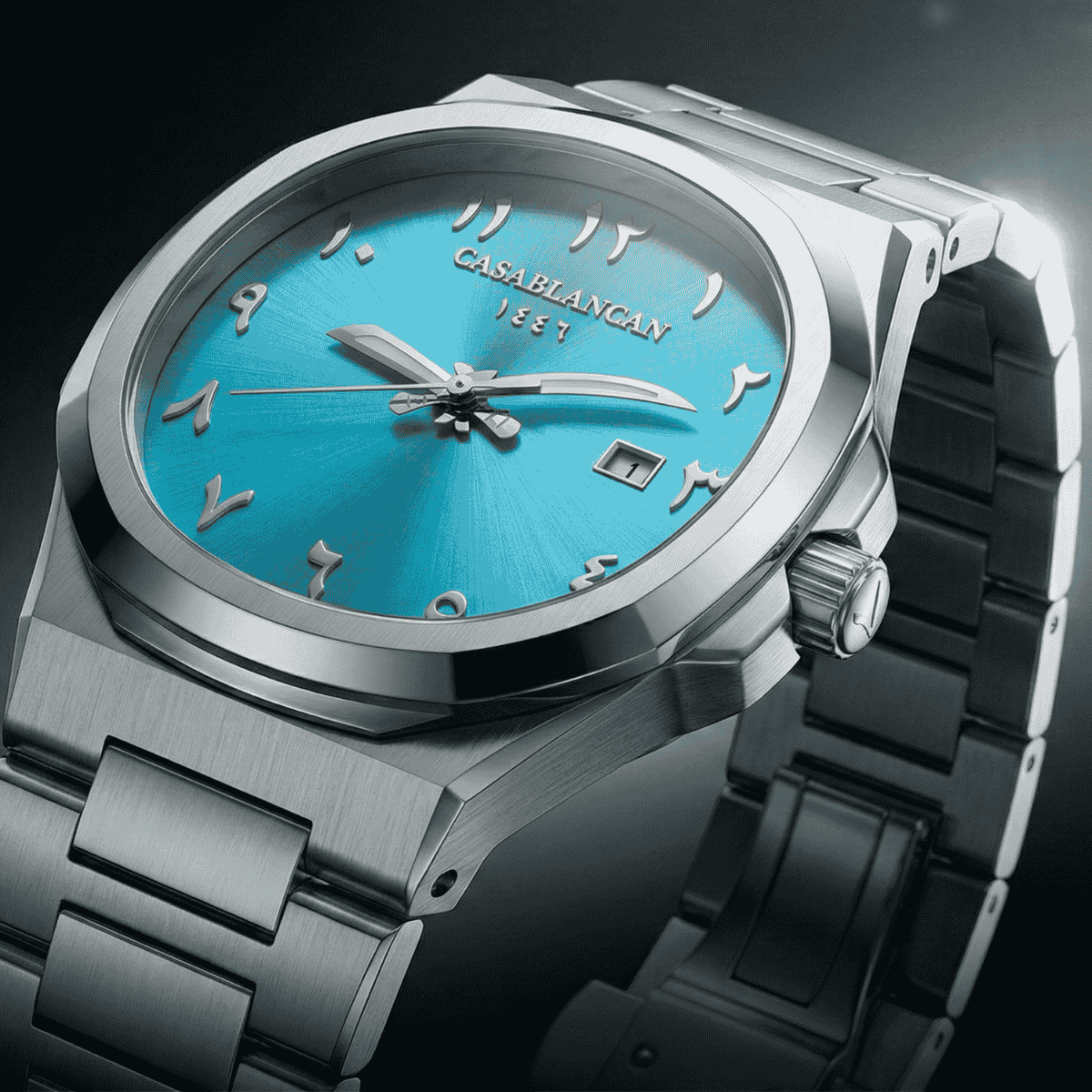
The Casablancan dial borrows the Khanjar's curve by shaping its hour and minute hands like the dagger, then setting them against Eastern Arabic numerals on a sunray dial. A traditional Khanjar is known for its sharply curved blade, and that outline is what the hands carry onto the face of the watch. Each hand keeps the dagger's silhouette, so you read the time from the tip of a small blade.
The minute hand runs longer than the hour hand, as on most watches, so the shape never forces you to learn a new way of reading.
The Casablancan dial pairs those dagger hands with Eastern Arabic numerals at every hour, from ١ at the one o'clock position to ١٢ at the top. Many watches show only a few numerals or none, but a full set gives the Khanjar hands a script from the same region to point toward. The Khanjar already signals place and identity, and the numerals add a second regional marker to the same face. Learning to read them takes only a few minutes of practice.
A sunray finish sits beneath the hands and numerals, with fine lines spreading out from the center so the dial shifts in tone as light moves across it. Casablancan offers that dial in green, black, brown or turquoise, and the Dune Heritage model uses the brown version. The radiating lines also echo the way both hands sweep outward from the center. On a brown dial, the effect suggests desert sand catching the sun.
The Dune Heritage case measures 43mm across and 11mm thick, made of 304 stainless steel with a matching steel bracelet and an adjustment tool included. A sapphire crystal covers the dial, and a quartz movement drives the Khanjar hands. The watch weighs 134g, which gives it a solid feel on the wrist. Its 3 ATM rating covers handwashing, light rain and splashes, so take it off before swimming or showering.

The Dune Heritage is our own watch at Casablancan, and it carries the Khanjar shape on the dial instead of at the belt. Its hour and minute hands are shaped like the Khanjar dagger, set over a brown sunray dial with Eastern Arabic numerals at every hour. The 43mm, 11mm-thick case and bracelet are 304 stainless steel, with sapphire crystal and a quartz movement. The Dune Heritage sells for $79.
How do you read the Eastern Arabic numerals on a khanjar-hand dial?
Eastern Arabic numerals on a khanjar-hand dial sit in the same hour positions as familiar Latin digits, so you read them exactly as you would any clock face. The symbols run ١ for 1, ٢ for 2, ٣ for 3, ٤ for 4, ٥ for 5, ٦ for 6, ٧ for 7, ٨ for 8 and ٩ for 9. Past nine, the numerals combine just like the digits you already use, so 10, 11 and 12 appear as ١٠, ١١ and ١٢. Once you know the first nine shapes, the top three hours follow on their own.
| Eastern Arabic | Western | How to spot it |
|---|---|---|
| ٠ | 0 | A small dot, not a circle |
| ١ | 1 | One upright stroke, like a Western 1 |
| ٢ | 2 | An upright stroke with one hook at the top |
| ٣ | 3 | An upright stroke with two hooks at the top |
| ٤ | 4 | Looks like a backward 3 |
| ٥ | 5 | A small circle, the one people mistake for zero |
| ٦ | 6 | A short top stroke and a straight drop, close to a 7 |
| ٧ | 7 | A V that opens upward |
| ٨ | 8 | An upside-down V |
| ٩ | 9 | Close to a Western 9 |
| ١٠ ١١ ١٢ | 10 11 12 | Two digits, read left to right like Western numbers |
The numeral ٥ causes the most confusion for newcomers, because the Eastern Arabic 5 looks like a Latin zero. The Eastern Arabic zero, ٠, is only a small dot, so a round loop on the dial always means five, never nothing. On the watch face, ٥ sits at the lower right, in the five o'clock position. The dot-shaped zero appears only inside ١٠, where it follows the ١ to make ten.
The numerals ٧ and ٨ form the second trap, since they share one shape turned in opposite directions. Seven, ٧, opens upward like a letter V, while eight, ٨, flips that shape so the open side faces down. On the dial, the two sit side by side at the lower left, which makes the contrast easy to check. If you remember that seven opens toward the top of the dial, eight falls into place.
A khanjar-hand dial becomes readable at a glance once you anchor on four positions: ١٢ at the top, ٣ at the right, ٦ at the bottom and ٩ at the left. Those quarter marks match every clock you have ever read, so the blade tip of the hour hand always lands between two known points. From there, count forward one symbol at a time until the shapes feel automatic.
For a first test, wait until the hour hand's tip rests at the lower left, then decide whether it points at ٧ or ٨.
Frequently asked questions
What does the kirpan symbolize?
The kirpan is tied in Sikh teaching to a duty to protect the vulnerable and to resist injustice. Many wearers carry the kirpan on a cloth strap, often beneath their clothes, and treat it with reverence instead of showing it off.
What does the khanda symbolize?
The khanda is a design with a double-edged sword at its center, a circle around it and two curved blades on either side. The word khanda also names the double-edged sword itself, and the symbol speaks to a religious commitment that crosses borders.
What does the word Khanjar mean in poetry and song?
The word Khanjar often turns into a figure for heartbreak, betrayal or a sudden wound in poetry and song. That figurative use shows how easily the word moves from naming a tool to describing a feeling.
Why is a Khanjar kept in its sheath?
A Khanjar kept sheathed signals a readiness to protect family and guests, not an eagerness to fight. Honor and manhood sit at the heart of its meaning, so wearing one is a statement of responsibility as much as strength.
Casablancan makes the Dune Heritage mentioned in this article.
Read more
Norqain has released the Wild ONE Skeleton X-Lite Turquoise, a 300-piece edition priced at EUR 10,650. It has a 41mm case of carbon composite, titanium and aluminium, weighs about 45 grams with str...

Louis Erard and watchmaker Vianney Halter released the Futur Antérieur, their third collaboration, reported by Worn & Wound on 2026-10-30. The 38mm steel watch holds two Sellita SW100 movements...