
How to read Eastern Arabic numerals on a watch dial
Quick answer: Read Eastern Arabic numerals by position, like any dial: ١٢ is at the top, ٣ at three o'clock, ٦ at six and ٩ at nine. The circle ٥ is five, not zero, and zero is a small dot. Seven opens upward like a V, and eight is the same shape upside down.
Timex has added the Easy Reader to its classic analog range, as Notebookcheck reported: a white dial with full Arabic numerals and black hands. Those are Western Arabic numerals, the 1 to 12 you see on most watches. Eastern Arabic numerals, the ١, ٢ and ٣ used in the Gulf, Egypt and the Levant, are rarer on a dial and take a few minutes to learn.
This guide shows you how to read them: which shapes stand for which hours, the two shapes that trip people up, and how to tell at a glance which kind of dial you are looking at.
Key facts
- Eastern Arabic numerals are in everyday use in the Gulf, Egypt and the Levant.
- Most watches sold with "Arabic numerals" use the Western digits 1 to 12.
- On an Eastern dial the circle ٥ is five; zero is written as a small dot.
- Seven opens upward like a V, and eight is the same shape upside down.
- Numbers above nine are written with two digits and read left to right.
Western or Eastern: what does an Arabic dial show?
You meet two numeral systems when you shop for an Arabic dial watch. Western Arabic numerals are the familiar 1, 2 and 3 on most watches, including the new Timex. Eastern Arabic numerals are a different set of shapes for the same values, and they are what most people in the Gulf picture when they hear the phrase.
A dial with Eastern numerals shows ١ for one and ٢ for two. Five is ٥, a small circle that looks like a Latin zero, while zero itself is a dot. Seven opens upward like a V, and eight is the same shape turned upside down.

Both systems are called Arabic numerals, which is why product listings can mislead. A watch sold with "Arabic numerals" usually has the Western digits, so if you want the Eastern set, look at the dial itself before you buy.
What the Timex Easy Reader adds to the analog range
The Easy Reader is a classic quartz watch in a 38 mm brass case, worn on a stainless steel expansion bracelet, with a backlight for reading it in the dark. Its white dial carries large Western Arabic numerals, black hands and a date window at three o'clock.
Timex now sells it through its store in India, with a launch discount for a limited time. For anyone who wants a dial that is quick to read, it is a clear example of the Western style: big, familiar numbers and nothing to decode.
The same need for a dial you can read at a glance applies to Eastern numerals. They are just as legible once the shapes are familiar, and the next section shows how quickly that happens.
How do you read Eastern Arabic numerals on a watch face?
Read an Eastern dial the way you read any dial: by position. The numeral at the top is ١٢, the one at three o'clock is ٣, at six you see ٦ and at nine ٩. Once you know those four anchors, the hours between them follow in order.
| Eastern Arabic | Western | How to spot it |
|---|---|---|
| ٠ | 0 | A small dot, not a circle |
| ١ | 1 | One upright stroke, like a Western 1 |
| ٢ | 2 | An upright stroke with one hook at the top |
| ٣ | 3 | An upright stroke with two hooks at the top |
| ٤ | 4 | Looks like a backward 3 |
| ٥ | 5 | A small circle, the one people mistake for zero |
| ٦ | 6 | A short top stroke and a straight drop, close to a 7 |
| ٧ | 7 | A V that opens upward |
| ٨ | 8 | An upside-down V |
| ٩ | 9 | Close to a Western 9 |
| ١٠ ١١ ١٢ | 10 11 12 | Two digits, read left to right like Western numbers |
Numbers above nine are written with two digits and read left to right, like Western numbers, so ten, eleven and twelve appear as ١٠, ١١ and ١٢. Two shapes cause most mistakes. The circle ٥ is five, not zero, and the V shapes for seven and eight are told apart only by which way they open.
Start with the hour hand. The minute hand points at a position rather than at a numeral, so once you can name the hours, the minutes take care of themselves. Most people read an Eastern dial without thinking after a day or two of wearing one.
How do you choose a watch with authentic Eastern numerals?
Regional design shows in more than the numerals. On some dials the hour and minute hands take the shape of the Khanjar dagger instead of plain batons, which ties the watch to a recognizable Gulf silhouette without extra decoration.
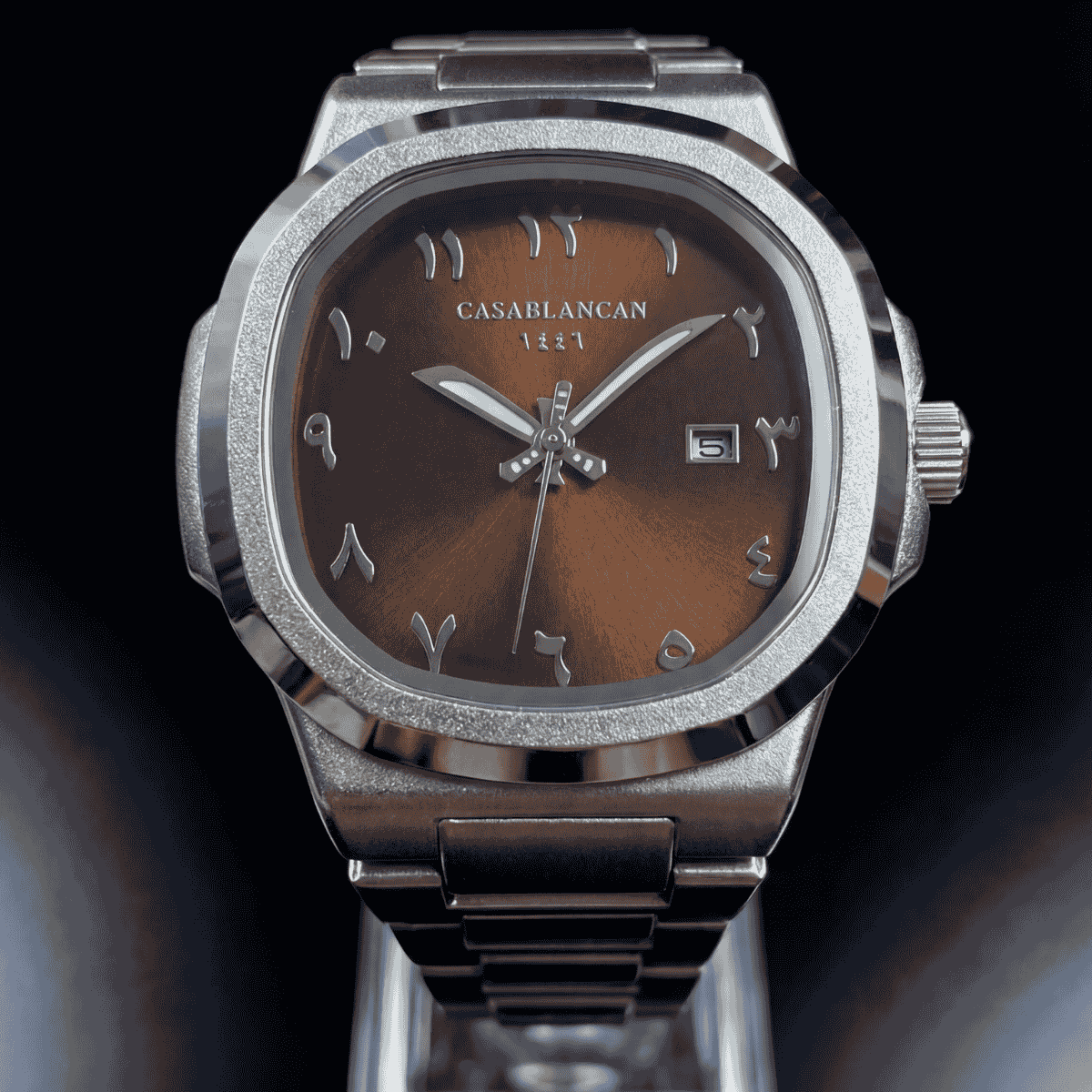
The Dune Heritage shows how these elements work together: Eastern Arabic numerals at every hour from ١ to ١٢, Khanjar-shaped hands and a brown sunray dial.
Before you buy, check the dial rather than the listing. Look for the circle at five and the V at seven. If you see 5 and 7 instead, the watch uses Western digits, whatever the description says.

You can explore this design on the Dune Heritage, a watch we make. It has Eastern Arabic numerals at every hour and hands shaped like the Khanjar dagger. The brown sunray dial sits in a 43mm stainless steel case with sapphire crystal and a quartz movement.
Frequently asked questions
Is ٥ five or zero?
It is five. The Eastern Arabic zero is a small dot, so a circle on an Eastern dial always means five.
Are Eastern Arabic numerals read from right to left?
No. Arabic text runs from right to left, but numbers are written and read from left to right, so twelve appears as ١٢ with the one first.
Which countries use Eastern Arabic numerals?
They are in everyday use in the Gulf, Egypt and the Levant. Morocco, Algeria and Tunisia mainly use the Western digits 1 to 12.
How can I tell whether a watch has Eastern or Western Arabic numerals?
Look at five and seven on the dial. A circle at five and a V at seven mean Eastern numerals; the shapes 5 and 7 mean Western digits.
How long does it take to learn to read an Eastern Arabic dial?
Most people read one without thinking after a day or two of wearing it, because the hands point at positions and only a few shapes look unfamiliar.
Casablancan makes the Dune Heritage mentioned in this article.