
Persian vs Arabic numerals on a watch dial, explained
Quick answer: Persian and Eastern Arabic numerals mark the same twelve hours on a watch dial and differ mainly at 4, 5 and 6. The Eastern Arabic four, five and six are ٤, ٥ and ٦, while Persian uses ۴, ۵ and ۶. Neither system tells time better, so legibility, dial contrast and personal taste decide.
Persian and Eastern Arabic numerals look alike on a watch dial, and both mark exactly the same twelve hours. The real difference is a handful of shapes, most visibly 4, 5 and 6, which each system writes its own way. Neither set tells time better than the other, so choosing a dial comes down to legibility and personal taste.
By the end of this guide, you will be able to read Eastern Arabic numerals hour by hour, from ١ at one o'clock to ١٢ at the top. You will also know the shapes that trip people up, such as ٥, which resembles a Latin zero, and ٧ and ٨, which mirror each other. With that skill, you can judge any dial on clarity and appeal instead of guesswork.
Key facts
- Persian and Eastern Arabic digits differ mainly at four, five and six, while the remaining digits share basic printed shapes.
- The Eastern Arabic four resembles a backward Latin 3, while the Persian four has a more angular form.
- The Eastern Arabic five is a small round loop, while the Persian five resembles an upside-down heart.
- The Eastern Arabic six is a single hooked stroke, while the Persian six adds a curl that changes its outline.
- Both systems write zero as a small dot, so the 10, 11 and 12 positions look identical in either.
- On a twelve-hour dial, only the 4, 5 and 6 o'clock markers reveal whether the numerals are Persian or Eastern Arabic.
Persian vs Arabic numerals on a watch dial: What is the difference?
Persian and Eastern Arabic numerals descend from the same written tradition, and that shared origin shows in how closely the two sets resemble each other on a watch dial. Both systems are read left to right as numbers, even when they appear inside right-to-left text.
Eastern Arabic and Persian digits split mainly at 4, 5 and 6. The Eastern Arabic four, ٤, looks a bit like a reversed Latin 3, while the Persian four, ۴, takes a more angular form. The Eastern Arabic five, ٥, is a small round loop, while the Persian five, ۵, has a rounded shape often compared to an upside-down heart.

The six shows the last real gap between the two sets. The Eastern Arabic six, ٦, is a single hooked stroke, and the Persian six, ۶, adds a curl that changes its outline. The remaining digits, from one through three and seven through nine, share the same basic shapes in print, and both systems write zero as a small dot.
A twelve-hour dial makes the overlap easy to see. The positions for 10, 11 and 12 use only the digits one, two and zero, so they look the same in either system. If you compare two dials side by side, the 4, 5 and 6 o'clock markers are the only places where you can tell Persian from Eastern Arabic at a glance.
How do you read Eastern Arabic numerals on a watch dial?
The dial helps you, because every numeral sits exactly where its familiar Latin counterpart would. Once the first nine shapes are clear, the final three hours take care of themselves.
| Eastern Arabic | Western | How to spot it |
|---|---|---|
| ٠ | 0 | A small dot, not a circle |
| ١ | 1 | One upright stroke, like a Western 1 |
| ٢ | 2 | An upright stroke with one hook at the top |
| ٣ | 3 | An upright stroke with two hooks at the top |
| ٤ | 4 | Looks like a backward 3 |
| ٥ | 5 | A small circle, the one people mistake for zero |
| ٦ | 6 | A short top stroke and a straight drop, close to a 7 |
| ٧ | 7 | A V that opens upward |
| ٨ | 8 | An upside-down V |
| ٩ | 9 | Close to a Western 9 |
| ١٠ ١١ ١٢ | 10 11 12 | Two digits, read left to right like Western numbers |
The first numerals on an Eastern Arabic dial are the gentlest to learn. ١ at one o'clock is a single upright stroke, very close to a Latin 1. ٢ at two o'clock adds one small hook at the top, and ٣ at three o'clock adds a second, giving it a slightly toothed edge. Then come ٤ at four, ٥ at five and ٦ at six, followed by ٩ at nine, which resembles a Latin 9 with its loop on top.
Read that loop as five every time. The true zero, ٠, is only a small dot, and on a twelve-hour dial it shows up just once, tucked inside ١٠ at the ten o'clock position. If a circle sits where five o'clock belongs, you are looking at a five.
The Eastern Arabic seven and eight form a mirrored pair on the left side of the dial. ٧ at seven o'clock opens upward like a V, while ٨ at eight o'clock is the same shape turned over, with its point at the top. A quick memory aid works well: seven opens toward the sky, and eight rises to a peak like a roof. The last three positions simply combine digits you already know, so ١٠, ١١ and ١٢ read as ten, eleven and twelve.
Which numeral style is easier to read at a glance?
Neither Persian nor Eastern Arabic numerals is easier to read by nature, because the two sets share nine of the twelve hour shapes and familiarity counts for more than script. After a few days with either dial, you will likely stop decoding symbols and start recognizing positions. That is the same habit you already use on a Latin dial. The differing shapes at four, five and six sit between familiar neighbors, so the layout fills in any gap.
Numeral shape still plays a part in how fast a dial reads. Simple, open forms with clear space between strokes stay distinct at small sizes, while fine curls can blur together on a crowded dial. Eastern Arabic digits lean toward single strokes and plain loops, which gives each hour marker a clean outline. Persian digits carry a few more curves, so their legibility depends more on how large and bold the printing is.
Dial contrast often matters more than the script itself. Light numerals on a dark dial, or dark numerals on a pale one, separate cleanly from the background in daylight. A sunray finish catches light and shifts in tone as you turn your wrist. Markers printed in a strongly contrasting color hold up best across those changes.
Hand design finishes the job of a quick read. Hour and minute hands that differ clearly in length tell you at once which is which, and a pointed tip lands precisely on a marker. Distinctive hand shapes let you judge the angle even when your eyes never settle on a numeral.
What makes a dial built around Eastern Arabic numerals work?
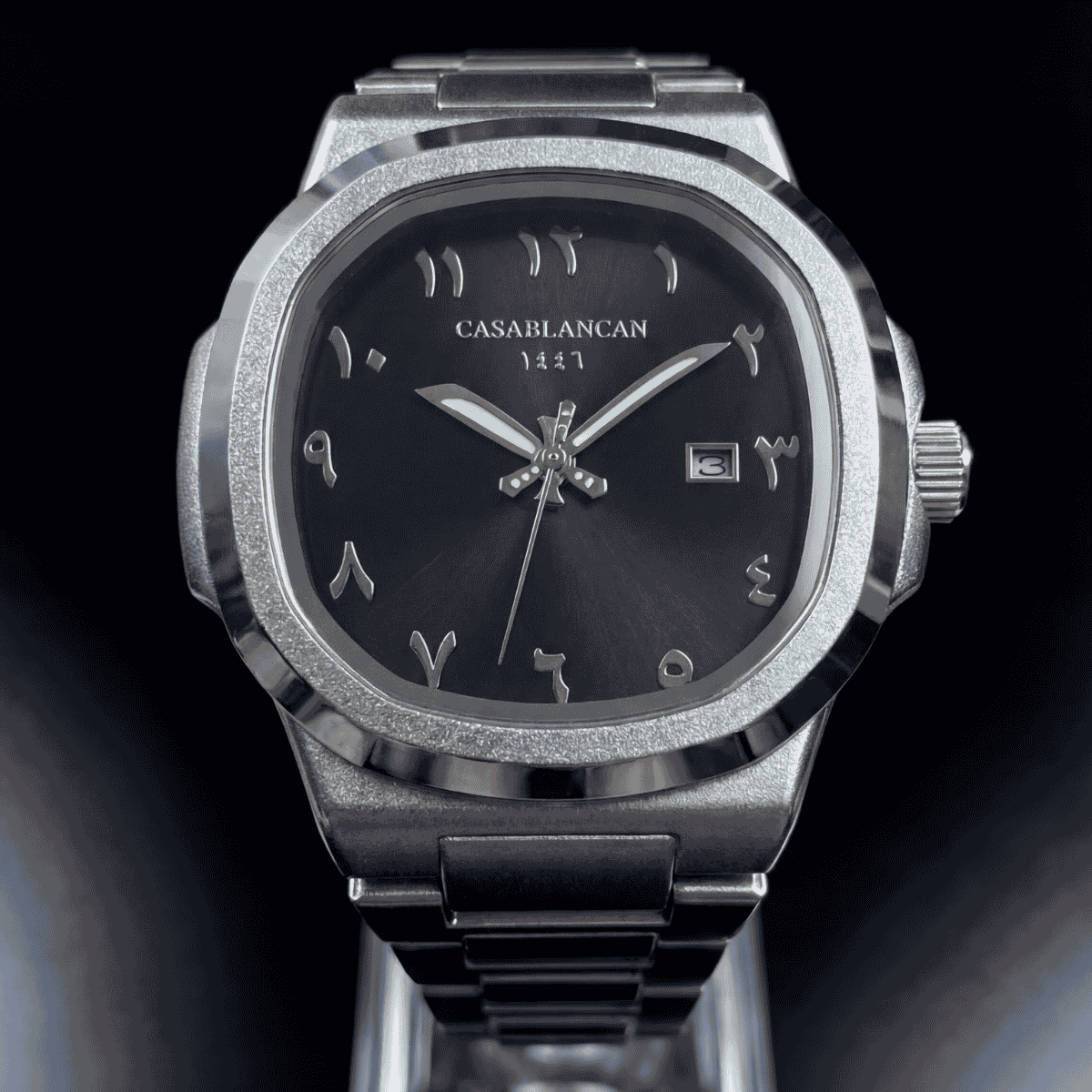
A dial built around Eastern Arabic numerals works when every hour carries its own numeral, the hands point clearly, and the background lets both stand out without competing. A full set of twelve numerals means you never count unmarked indices to work out whether a hand points at eight or nine. Each hour confirms itself, so any glance at the dial tells you where you stand. A case around 43mm wide leaves enough room for twelve numerals to sit apart without crowding the center.
Khanjar-shaped hands give the layout a matching character. The Khanjar is a curved dagger traditionally worn in Oman and nearby regions, and its tapered blade suits a watch hand with a sharp tip. Shaping both the hour and minute hands this way keeps them in the same visual family as the numerals. Their different lengths still separate them, so style never costs you clarity.
A sunray dial ties the pieces together. Fine lines radiate from the center, so light sweeps across the surface as your wrist turns and gives depth to an otherwise plain field. Against a black sunray dial, for example, numerals and dagger hands stand out while the background moves from shadow to soft shine. Script, hands and finish end up drawing on one visual language instead of sitting side by side as separate ideas.

The Onyx Sentinel is our own watch at Casablancan, and it puts the legibility question to a simple test. Eastern Arabic numerals mark every hour on a black sunray dial, with hour and minute hands shaped like the Khanjar dagger. The 43mm, 11mm-thick case is 304 stainless steel, with sapphire crystal and a quartz movement. At $89, it lets you judge whether those hour markers read clearly to your eye.
Choosing between Persian and Eastern Arabic numerals for your watch
Neither script changes how a watch keeps time or where the hands point. The choice rests with your eyes and your taste, so you can weigh those two things without worrying about getting it wrong.
Personal connection is a fair reason to lean one way. A dial in the script your family wrote, or the one you saw on street signs while traveling, can make each glance feel familiar.
Daily use deserves equal weight. Think about where you check the time most often, whether that is across a desk, behind the wheel or under dim evening light. A watch you read quickly in those moments will earn its place on your wrist faster than one you only admire.
A simple test settles the question before you commit. Hold a dial or a clear photo of one at arm's length, then name the hours at four, five and six without counting from twelve. Whichever script lets you call out those three markers without pausing is the one to wear.
Frequently asked questions
What does zero look like in Eastern Arabic numerals?
The Eastern Arabic zero, ٠, is a small dot rather than a circle. On a twelve-hour watch dial, that zero appears only once, tucked inside ١٠ at the ten o'clock position.
Why is the Eastern Arabic five often mistaken for zero?
The Eastern Arabic five, ٥, is a small round loop that resembles a Latin zero. The true Eastern Arabic zero is only a small dot, so a circle at the five o'clock position always means five.
How can you tell the Eastern Arabic seven and eight apart?
The Eastern Arabic seven, ٧, opens upward like a V, while the eight, ٨, is the same shape turned over with its point at the top. A handy memory aid: seven opens toward the sky, and eight rises to a peak like a roof.
Are Eastern Arabic numerals read right to left?
Eastern Arabic and Persian numbers are read left to right, even inside right-to-left text. On a watch dial, ١٠, ١١ and ١٢ read as ten, eleven and twelve, just like Western two-digit numbers.
What is a khanjar-shaped watch hand?
Hour and minute hands shaped this way still differ in length, so they stay easy to tell apart.
Casablancan makes the Onyx Sentinel mentioned in this article.
Read more
Girard-Perregaux has released the Laureato Fifty Three Gold Bridges, reported by Yahoo Shopping on October 27, 2026. It costs $182,000 and is not limited. Rose gold bridges, hands and indices repla...
Norqain has released the Wild ONE Skeleton X-Lite Turquoise, a 300-piece edition priced at EUR 10,650. It has a 41mm case of carbon composite, titanium and aluminium, weighs about 45 grams with str...