
How to judge arab watch brands by the dial, not the name
Quick answer: An Arab watch brand is worth choosing when its watches pass three checks: a dial that reads quickly, a case that suits daily clothes, and a price matched to use. Eastern Arabic numerals read easily when every hour is marked and the hands stand clear of the dial. Case thickness matters most under a fitted shirt cuff.
Arab watch brands draw real curiosity, but a name alone tells you little about how a watch will serve you. A good one earns its place through three tests: how clearly the dial reads, how the watch wears with the clothes you put on, and whether the price fits your use. Eastern Arabic numerals and a sunray color look striking, but the test is whether they still work on your wrist every day.
By the end of this guide, you will read an Eastern Arabic dial at a glance and know when a design helps legibility. You will see how case size and thickness decide whether a watch shows under a loose thobe sleeve or hides beneath a shirt cuff. Then you can judge whether a price makes sense for how often you plan to wear it.
Key facts
- Judge an Arab watch brand on three checkable tests: dial legibility, everyday wearability, and a fair price for its use.
- Eastern Arabic numerals stay easy to read when every hour is marked and the hands stand out from the dial.
- Eastern Arabic digits are written left to right like Western digits, and the symbol ٠ stands for zero.
- Khanjar-shaped hands have a broad body and a pointed tip, so you can tell time from hand position alone.
- With fitted shirt cuffs, case thickness matters more than diameter, so try any watch with your usual shirts first.
- Pick a water resistance rating for your wettest realistic moment, since diving features add cost without helping daily wear.
What should you look for in Arab watch brands?
Judge an Arab watch brand on three things you can check: a dial that reads at a glance, a case that suits daily dress, and a fair price for its use. A brand name can tell you where a watch comes from and what it hopes to stand for. A name cannot tell you whether you will reach for that watch on an ordinary Tuesday. The three tests below can.
A readable dial is the first test, because a watch exists to tell you the time quickly. Look at how the numerals, hands and dial color work together under ordinary indoor light. Eastern Arabic numerals can carry identity and still read clearly when every hour is marked and the hands stand out from the background. A sunray finish shifts as light moves across it, so check that the hands stay visible at every angle.

Everyday wear is the second test, and proportion matters more than ornament here. A case that is too thick fights a shirt cuff, while a loose sleeve forgives far more. Ask whether the watch pairs with clothes you already own, from a thobe to a work shirt. One simple habit helps any watch look settled: match the dial color to one other thing you wear.
Price is the third test, measured against how you will use the watch rather than against a reputation. A watch for daily wear should earn its cost through comfort and legibility you notice every week. Read the warranty and return terms too, since they show how a brand stands behind its work.
How do Eastern Arabic numerals and Khanjar hands change the way a dial reads?
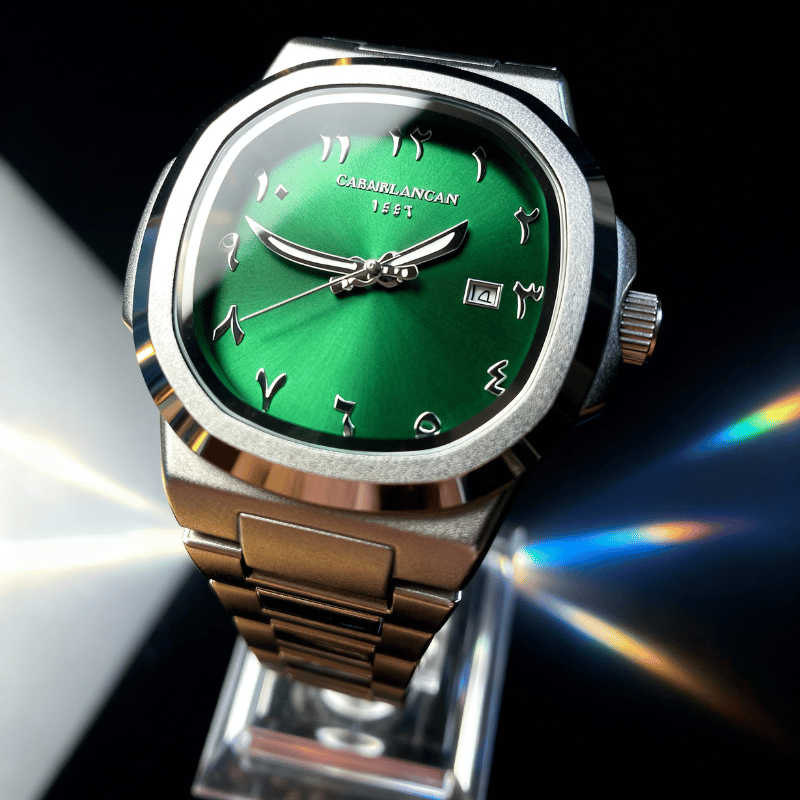
Eastern Arabic numerals ask you to learn a new shape for each hour, while Khanjar hands keep the time easy to find, since each blade narrows to a clear point. On the Casablancan dial, a numeral sits at every hour, so you never count blank spaces between markers. The digits run ١ through ٩, then ١٠, ١١ and ١٢, written left to right just as Western digits are, with ٠ standing for zero.
Once you notice that ٧ and ٨ look like a V and an upside-down V, the other shapes come with a little practice.
Casablancan shapes both the hour and minute hands after that blade, giving each one a broad body and a tapered tip. The wide section catches your eye first, and the tip lands on a numeral. You can judge the time from hand position alone, even before you read the digit underneath.
The sunray finish on a Casablancan dial is brushed in fine lines that spread out from the center, so the surface brightens and darkens as you tilt your wrist. The dial comes in green, black, brown or turquoise, and each shade shifts in tone as light moves across it. That movement gives the dial depth, which is why checking the hands at several angles matters.
The Casablancan case measures 43mm across and 11mm thick, made of 304 stainless steel. That diameter leaves room for twelve numerals large enough to read without crowding the hands. Sapphire crystal covers the dial and resists the scratches that can cloud a view over years of wear. A quartz movement drives the hands, so the watch keeps running without winding.

The Green Sunray Khanjar is our own Casablancan watch, so you can test this guide's argument on it. Eastern Arabic numerals mark every hour on a forest green sunray dial, and the hour and minute hands take the shape of the Khanjar dagger. The 43mm, 11mm-thick case and bracelet are 304 stainless steel, with sapphire crystal and a quartz movement. At $89, it suits everyday wear, and its 3 ATM rating covers handwashing, light rain and splashes.
Does a 43mm watch work with a thobe, a kandura or a tailored shirt?
At that point the case neither slides onto the back of your hand nor crowds your forearm. A bracelet that feels snug without pinching will keep it there through a full day.
The dial stays in view whether you are checking the time or simply resting your hand on a table. That open sleeve suits a dial with a numeral at every hour, since the whole face is on show. Against white or cream fabric, a steel case adds a clean, bright line at the wrist.
A tailored shirt is the stricter test, and thickness matters more than diameter there. A thicker case can push the cuff open or leave a visible bulge along the sleeve. If you wear fitted cuffs most days, try any watch with your usual shirts before you decide.
Color matching works the same way with a robe or a shirt. A green dial can echo an olive jacket or the green thread on an embroidered collar. A brown dial pairs naturally with a leather belt or shoes, and a black one sits easily beside dark trousers. A turquoise dial can pick up a tie, a pocket square or a stone in a ring.
What are famous watch brands, and should a well-known name decide your choice?
Famous watch brands are the long-established houses, many of them Swiss or Japanese, whose names carry weight, but a well-known name should not decide your choice on its own. A famous label usually signals a long history, a wide service network and a design language people recognize from across a room. Those qualities have value, yet they say little about how a particular dial reads on your own wrist.
A watch's reputation and its everyday usefulness are separate questions. Some celebrated models use small indices, thin hands or a crowded layout of subdials that can be hard to read in dim light or at an angle. Others are styled for a dress code that may not match what you wear most days. A name you recognize cannot fix a dial you have to squint at.
A better test for any watch, famous or not, is one you can run yourself in a few minutes. Check whether the hour registers before you consciously read it, and whether the numerals use the script you read most easily. Then picture the watch with clothes you already own, from a loose robe at a family gathering to a fitted shirt at the office.
The brands deserve to be judged by that same standard. A smaller maker that gets legibility and wearability right can serve you better every day than a famous label chosen mainly for its logo.
Matching a watch's price and water resistance to how you actually wear it
Pay for the features your days actually call for, and pick a water resistance rating that matches the wettest moment your watch will realistically face. A watch worn to the office, family dinners and weekend errands needs a readable dial, a sturdy case and a crystal that shrugs off scratches. Features built for diving or extreme sport add cost without helping that routine. Spending more only makes sense when the extra money buys something you will use.
Quartz watches ask for little attention beyond an occasional battery change. They also tend to cost less to build and service, so more of your budget can go toward a better case, dial or crystal.
In practice it covers washing your hands, walking through light rain and the odd splash at the sink. Showering and swimming are off the list, since hot water, soap and sudden pressure can work past the seals. If you swim laps or shower with your watch on, look for a higher rating instead.
Before you shower, swim or wash the car, take the watch off and set it somewhere dry. After rain or a splash, wipe the case and bracelet with a soft cloth before putting it away.
Frequently asked questions
Which watch brands are considered famous?
Famous watch brands are long-established houses, many of them Swiss or Japanese, whose names carry weight.
Does a well-known watch name guarantee an easy-to-read dial?
A well-known name does not guarantee legibility. Some celebrated models use small indices, thin hands or crowded subdials that can be hard to read in dim light or at an angle. A recognized logo cannot fix a dial you have to squint at.
How do you read Eastern Arabic numerals on a watch dial?
Eastern Arabic digits run ١ through ٩, then ١٠, ١١ and ١٢, written left to right like Western digits, with ٠ standing for zero. The numerals ٧ and ٨ look like a V and an upside-down V, and the other shapes come with a little practice.
What does a sunray watch dial look like?
A sunray dial is brushed in fine lines that spread out from the center, so the surface brightens and darkens as you tilt your wrist. That shifting tone gives the dial depth, so check that the hands stay visible at every angle.
Why does sapphire crystal matter on a watch?
Sapphire crystal covers the dial and resists the scratches that can cloud your view over years of wear. A clear, unscratched crystal helps the numerals and hands stay easy to read day after day.
Casablancan makes the Green Sunray Khanjar mentioned in this article.
Read more
They were unveiled on 24 October at Jewel of Joy in Dubai Gold District, and Gulf News said both titles were officially verified.
Hodinkee reports that Audemars Piguet, the Le Brassus watchmaker, is launching The Watch Keepers, a digital marketplace for brand-certified pre-owned Audemars Piguet watches that are at least two y...