
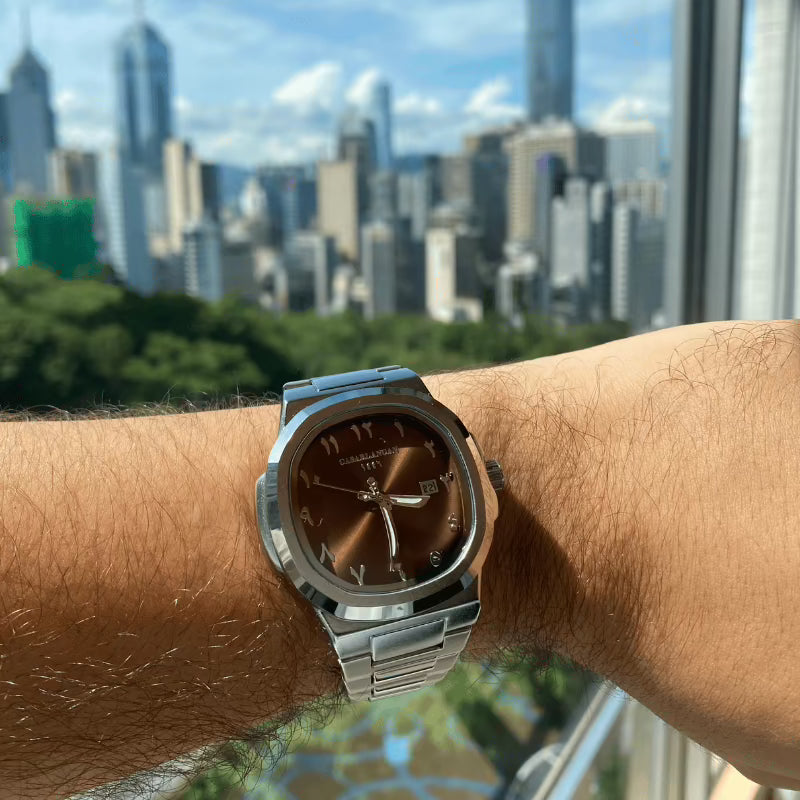
How to choose an Arabic dial watch you can actually read
Quick answer: Choose an Arabic dial watch by checking three things: numerals you can read at a glance, a case that fits your wrist, and a water rating matching your routine. Test numerals by glancing one second, then saying the time. A good case sits flat, lugs ending inside your wrist's edges. Modest ratings handle handwashing and splashes, not swimming.
Choosing an Arabic dial watch comes down to three practical questions. Can you read the Eastern Arabic numerals at a glance, does the case size suit your wrist, and does the water rating match how you actually wear it? A dial that looks striking but makes you squint at the time is a poor companion for daily wear.
By the end of this guide, an Arabic dial should feel as readable as any other watch face. You will be able to read the numerals from ١ to ١٢ without hesitating, including two shapes that often trip people up. You will know how to judge whether a case size suits your wrist. You will also be able to match a water rating to your routine, from handwashing to a walk in the rain.
Key facts
- Before buying, glance at the dial for one second and say the time aloud to test how readable it is.
- A case that fits well sits flat, with its lugs ending inside the edges of your wrist.
- Match the water rating to your real routine, since modest ratings cover handwashing and splashes while swimming needs far more.
- An Eastern Arabic dial is read like any analog watch, with the same hands, direction and twelve hour positions.
- A dial with a numeral at every hour helps newer readers, because each glance links a symbol to its hour.
- The hour hand should be shorter and broader, while the minute hand should reach close to the numeral ring.
How to choose an Arabic dial watch you will wear every day
Each check rules out a different kind of regret. A dial you squint at, a case that overhangs your wrist, or a rating that fails you at the sink will all push a watch into a drawer.
Numerals you can read quickly are the first check, because an Arabic dial only earns daily wear once the digits feel natural. Most people learn the ten digits in an afternoon, and a dial gives you steady practice since each hour always sits in the same spot. Test yourself before you commit: glance at the dial for one second, then say the time out loud. If you still find yourself counting around from the top, the design may be working against you.

Wrist fit is the second check, and it depends on your own build rather than on what looks bold in a photo. A case that suits you sits flat, with the lugs ending inside the edges of your wrist. Thickness counts as well, because a tall case snags on shirt cuffs and jacket sleeves over a long workday. Try a watch with the clothes you wear most, not just with a bare arm.
A water rating is the third check, and it should match your real routine rather than an imagined one. Picture where your hands go on an ordinary day: the bathroom sink, the drizzle on your commute, the shower, the pool. A modest rating handles handwashing and splashes, while swimming calls for far more. Knowing those limits up front tells you which moments mean taking the watch off and setting it aside.
How do you read Eastern Arabic numerals on a watch dial?
You read an Eastern Arabic dial the same way you read any analog watch, matching each symbol to its usual hour position, from ١ at one o'clock around to ١٢ at the top. The hands, the direction they travel and the twelve positions all stay exactly as you know them. Only the shapes marking each hour change, so the real task is learning twelve symbols that never move. Start with the four quarter markers, ١٢, ٣, ٦ and ٩, because they anchor every glance you take.
| Eastern Arabic | Western | How to spot it |
|---|---|---|
| ٠ | 0 | A small dot, not a circle |
| ١ | 1 | One upright stroke, like a Western 1 |
| ٢ | 2 | An upright stroke with one hook at the top |
| ٣ | 3 | An upright stroke with two hooks at the top |
| ٤ | 4 | Looks like a backward 3 |
| ٥ | 5 | A small circle, the one people mistake for zero |
| ٦ | 6 | A short top stroke and a straight drop, close to a 7 |
| ٧ | 7 | A V that opens upward |
| ٨ | 8 | An upside-down V |
| ٩ | 9 | Close to a Western 9 |
| ١٠ ١١ ١٢ | 10 11 12 | Two digits, read left to right like Western numbers |
The first four hours on an Eastern Arabic dial use some of the simplest shapes. At one o'clock, ١ is a single upright stroke, close to a Latin 1 stripped down to its spine. At two o'clock, ٢ is a similar stroke with a short flick at the top, and at three o'clock, ٣ adds a second small bump along that top edge. Four o'clock carries ٤, which looks somewhat like a Latin 3 seen in a mirror.
The lower half of an Eastern Arabic dial runs from ٥ to ٨, and the shapes grow more compact there. At five o'clock, ٥ is a small rounded loop, while six o'clock holds ٦, a stroke with a short hook at its top. Seven o'clock shows ٧, which opens upward like a V, and eight o'clock shows ٨, the same angle turned point up. Since those two sit side by side, their fixed places on the dial help you keep them straight.
The last stretch of an Eastern Arabic dial climbs from ٩ back to the top. At nine o'clock, ٩ resembles a Latin 9 with its loop held high, so most readers place it on sight. The three remaining hours use two digits each, written left to right just like Western numbers, so ١٠ is a one followed by the small dot that means zero. Next comes ١١, two upright strokes for eleven, and then ١٢ at the top, which pairs a one with a two.
Which Arabic numerals are easiest to mix up?
The shapes that catch new readers most often are ٥ (5), which resembles a Latin zero, and the pair ٧ (7) and ٨ (8), which share one shape turned opposite ways. Both mix-ups come from habit rather than difficulty. Your eye has spent years treating a round loop as zero and a V as a letter, so the old meaning fires first. Knowing which shapes trigger that reflex makes the slip easier to catch.
The Eastern Arabic five, ٥, is the symbol most likely to fool you, since a small oval reads instantly as 0 to Western eyes. That means any loop standing alone on the dial cannot be zero. If you spot an oval at the five o'clock position, you are looking at five.
The pair ٧ and ٨ causes the second common slip, because each one is the other turned over. A simple memory aid helps: ٧ opens upward like a cup, while ٨ points upward like a roof. On the dial, seven comes just before eight as the hour hand climbs the left side toward nine. Remember that the open cup comes first, and the order settles quickly.
A short practice routine fixes both pairs in your memory. For the next several days, name the numeral under the hour hand each time you check your watch. Pay extra attention whenever the hand passes five, seven or eight. After enough glances, those shapes start to read as numbers rather than puzzles.
What makes an Arabic dial readable at a glance?
An Arabic dial reads fastest when a numeral sits at every hour, the two hands differ clearly in shape and length, and both hands stand out sharply against the dial color. Each of those features removes one small step between a glance and the time. A full ring of twelve numerals means you never have to count from a neighboring marker. Distinct hands mean you never stop to wonder which one points at the hour.
Numerals at every hour matter more on an Eastern Arabic dial than on a familiar Western one. Many dials print only a few key numbers and fill the other positions with plain bars, so you have to work out the missing hours from position alone. That shortcut works once the numbers feel natural, but it gives a newer reader fewer chances to see each shape in its place. When all twelve numerals are printed, every glance confirms a symbol and its hour together.
Hand shape is the next thing to judge, since the hour and minute hands carry different information. The hour hand should be visibly shorter and broader, while the minute hand should reach close to the numeral ring. Some designers give the hands a recognizable outline, such as a traditional curved dagger, which hands your eye a silhouette it can find instantly. Whatever the style, check that the tips point cleanly at the numerals instead of covering them.
Contrast between the hands and the dial decides how readable a watch stays as the light changes. Polished steel hands can disappear against a pale dial when they catch a reflection. A deeper dial color, such as blue, green or turquoise, tends to keep bright hands and printed numerals easy to pick out. A sunray finish shifts in tone as you tilt your wrist, so look at any dial from several angles before you decide.
How big should a watch be for your wrist?
Diameter gets most of the attention, but the distance from one lug tip to the other often decides whether a case looks balanced. Measure just below the wrist bone with a strip of paper or a soft tape before you compare sizes.
Case thickness matters as much as width once you wear long sleeves. A watch around 11 or 12mm thick usually slides under a dress shirt cuff, while noticeably thicker cases tend to catch on the fabric. A slimmer profile also helps a steel watch stay put, since weight sitting high on the wrist tends to tip the case sideways. If you wear buttoned cuffs most days, check that the cuff closes over the case before you settle on a size.
A steel bracelet feels right only when it is sized to your wrist, which is why adjustable links matter. Most steel bracelets use removable links held by small pins or screws, and a simple tool lets you take out or add links at home. Aim for a fit loose enough to slide one finger under the clasp, yet snug enough that the dial stays centered on top. Wrists swell slightly in heat and after exercise, so a bracelet with a little room stays comfortable through a full day.

The Al Majaz is our own watch at Casablancan, and it lines up with the three checks in this guide. The 43mm stainless steel case is 11mm thick, the watch weighs 134g, and the bracelet comes with an adjustment tool. It is rated 3 ATM for handwashing, light rain and splashes, not for swimming or showering, and costs $89. It belongs to our Arabic dial watches collection.
Which water rating suits the way you actually wear a watch?
For most men, a basic water rating suits everyday wear, as long as the watch comes off before you swim or step into the shower. A water rating describes the pressure a sealed case held during a lab test, not a depth you can safely reach while wearing it. The meter figure on a case back can sound generous, yet a basic rating is meant only for brief contact with water.
Washing your hands, getting caught in light rain on the walk to work and catching splashes at the kitchen sink all fall within that range.
A basic water rating calls for removing the watch before swimming because moving through water adds pressure the seals were never meant to handle. Every stroke and push off a wall drives water against the case harder than standing still would. Showers bring a different risk: hot water and steam make the rubber gaskets expand and contract, while soap and shampoo can wear them down over time. Taking the watch off first costs you a few seconds and protects the seals that keep moisture out.
A watch you wear to the office, out to dinner and on weekend errands rarely meets more water than a basic rating allows. If you swim laps, fish from a boat or spend summer weekends at the lake, a rating built for full submersion makes more sense. Match the rating to the wettest hour of your usual week, not to a vacation you take once a year. That choice keeps you from paying for capability you never use or risking a watch that was not built for your habits.
A steel bracelet stays clean with very little effort when you wipe it often. Skin oil, sunscreen and dust collect between the links, and over a few weeks they dull the finish. Run a soft, dry cloth along the bracelet and clasp, working into the gaps between links where grime settles. Keep that cloth on the dresser or tray where your watch rests overnight, so the quick wipe becomes part of taking it off each evening.
Frequently asked questions
How long does it take to learn Eastern Arabic numerals?
Most people learn the ten Eastern Arabic digits in a single afternoon. A watch dial adds steady practice, because each hour symbol always sits in the same spot.
How can you test whether an Arabic dial is easy for you to read?
A quick test for an Arabic dial is to glance at it for one second, then say the time out loud.
What does the small dot mean on an Eastern Arabic dial?
On an Eastern Arabic dial, the small dot ٠ stands for zero. That is why ١٠ at ten o'clock reads as a one followed by the dot, written left to right like Western numbers.
How do you tell the Eastern Arabic numerals ٧ and ٨ apart?
The Eastern Arabic numerals ٧ and ٨ share one shape turned opposite ways. Think of ٧ as a cup opening upward and ٨ as a roof pointing upward. On the dial, seven comes just before eight.
Why does watch case thickness matter for everyday wear?
Watch case thickness matters because a tall case snags on shirt cuffs and jacket sleeves over a long workday. Trying a watch with the clothes you wear most shows whether its height suits your routine.
Casablancan makes the Al Majaz mentioned in this article.
Read more
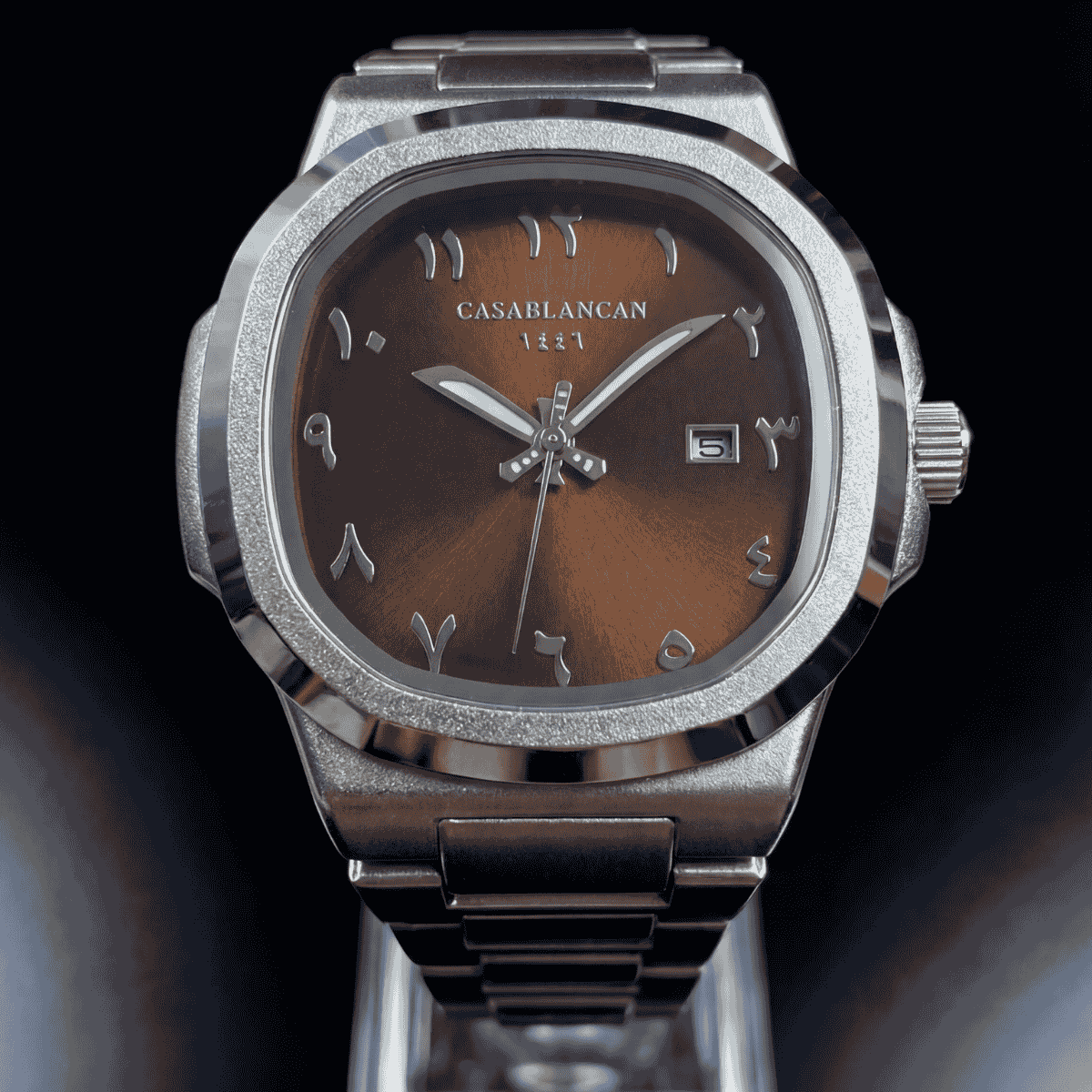
Hamilton's American Classic Cushion collection, reported by aBlogtoWatch on 2026-11-01, launches in six versions inspired by the Cushion Plain and Cushion Engraved watches of 1926. All use the new ...
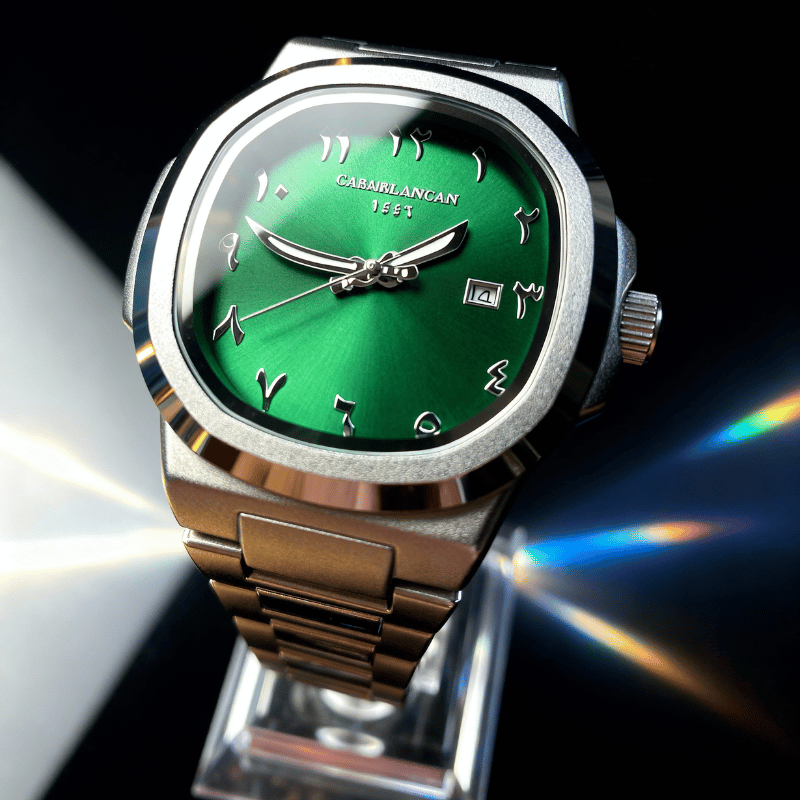
Oris has added an oxblood red dial to its Big Crown Pointer Date, Monochrome reported on 2026-11-03. The reference 01 754 7798 4038-07 8 20 06 joins the permanent collection, retails for CHF 2,000 ...