
Omani Khanjar vs Yemeni jambiya on a watch dial, explained
Quick answer: Choose an Omani Khanjar for a sharp, hooked hand that points cleanly at the hour, with a flat-topped hilt. Choose a Yemeni jambiya for a broader, gently curved hand with a rounded hilt that stays calm in every position. The Khanjar suits quick glances under a tailored shirt cuff, while the jambiya's steady presence suits a thobe or kandura.
Choosing between an Omani Khanjar and a Yemeni jambiya on a watch comes down to three things: the blade's curve, the hilt's shape, and the dress you will wear it with. The Omani Khanjar bends sharply, with a sheath that turns upward almost at a right angle. The Yemeni jambiya usually follows a wider, gentler sweep. On a dial, those differences show up in how each pair of hands points and balances.
By the end of this guide, you will be able to tell the two dagger shapes apart on a dial at a glance. You will also be able to judge which one suits a thobe, a kandura or a tailored shirt. Case size and thickness shape that choice too, so you will know what to look for before deciding.
Key facts
- The Omani Khanjar has a sharp hook and flat-topped hilt, while the Yemeni jambiya has a broader blade and rounded hilt.
- As a watch hand, the Khanjar runs mostly straight before a clear hook near the tip, pointing cleanly at the hour.
- A jambiya-style hand bends gently along its whole length, so the time is read from its overall direction.
- At the center post, flat Khanjar hilts form a crisp, compact hub, while rounded jambiya hilts stack into a bolder cluster.
- The Khanjar appears on Oman's national flag, while the jambiya carries an association with Yemeni dress.
- The Khanjar's hook suits quick glances under a tailored cuff; the jambiya's steady sweep suits a loose thobe or kandura sleeve.
Omani Khanjar or Yemeni jambiya on a watch?
The Omani Khanjar is the pick if you want a sharp, hooked silhouette and a flat-topped hilt that keeps the center of the dial tidy. The Khanjar appears on Oman's national flag, so it pairs naturally with Gulf dress such as a thobe or kandura. Its hook also points cleanly at the hour, which makes it the practical choice when a tailored shirt's cuff hides the watch most of the day.
The Yemeni jambiya is the pick if you prefer a broader, fuller blade and a rounded hilt that gives the hand a heavier anchor at the pivot. The jambiya belongs to Yemeni dress and carries that regional association onto the dial. The sections below explain how the blade's curve, the hilt's shape and your clothes each change the way the hands read.
How does the blade's curve read on a dial?
A Khanjar's sharp upturn becomes a slim hand with a clear hook near the tip, while a jambiya's broader curve becomes a fuller hand that bends gently along its whole length. On a khanjar-style hand, most of the length runs fairly straight before it turns. That straight run keeps the hand pointing cleanly at an hour marker.
A khanjar-style hand also changes character as it travels around the dial. Near twelve, the hook lifts like a raised tip. Near three or nine, the bend faces up or down, so the hand's outline shifts through the day. You notice the hook first and the time second, which gives the dial a sense of movement even when you glance quickly.

A jambiya-style hand works differently because its weight sits in the blade rather than at the point. The wider sweep fills more space, so the hand reads as one broad arc instead of a line with a hook. You tend to read the time by the hand's overall direction. The tip matters less, and the shape stays calm in every position.
A sunray dial makes these contrasts easier to see. The Khanjar's narrow hook cuts a thin line across the shifting light, while the jambiya's fuller blade shows a larger surface. If you check the time in quick glances, the hook makes a sharper pointer. If you want hands that hold their presence on the dial, the broader sweep gives you that.
What does the hilt shape add to a watch hand?
The hilt sets where a hand carries its weight: the Khanjar's flat top keeps the center light and tidy, while the jambiya's rounded hilt gives the pivot a fuller anchor. On a watch, the hilt end sits at the central post, the one part of the hand that barely moves. A flat-topped Khanjar hilt finishes in a clean edge, so your eye slides outward toward the hook. The balance of the hand tips toward its point.
A jambiya-style hilt swells into a rounded knob, and that curve gathers visual weight at the middle of the dial. The hand looks rooted, as if it turns around a heavier base. Paired with the broad blade, the whole shape reads as evenly loaded from one end to the other. That steadiness suits you if you want a dial that feels settled rather than sharp.
The hilt shape also changes how the hour and minute hands meet. With Khanjar hilts, the two hands overlap at the center as a pair of neat, flat caps, so the hub stays crisp and compact. With rounded jambiya hilts, the two bases stack into a soft cluster that looks bolder up close. On a sunray dial, a flat cap catches light along a single edge, while a rounded hilt shows a gentler shift from bright to dark.
Which dagger dial suits a thobe or a shirt?
A thobe or kandura leaves the whole dial on show, so pick the dagger shape you enjoy most, while a tailored shirt favors a hand you can read at a glance. A watch of this size sits just above the wrist bone, where a loose sleeve leaves it uncovered. Every time your arm moves, the hands are in view. A jambiya-style hand suits that setting, because its broad sweep keeps a steady presence in every position.
A tailored shirt changes the routine, since a slim case slides under the cuff and stays hidden until you want the time. You pull the cuff back, look, and let it fall again. The Khanjar's hook earns its place in that brief moment, pointing cleanly at the hour before the sleeve covers the dial. If most of your week is spent in collared shirts, the sharper pointer is the practical choice.
Dial color is the final decision, and the simplest rule is to match it to one other thing you wear. A green, black, brown or turquoise sunray dial can echo a pocket square, a belt, your shoes or the thread in an embroidered collar. One echo is enough, because matching several pieces makes an outfit look staged rather than worn. A brown dial with brown leather shoes, for example, ties the look together without drawing attention to itself.
A white thobe or kandura gives the dial more room to stand out, since the garment adds little color of its own. In that case the matching item can be small, such as sandals or a cap, and the sunray finish carries the rest. Under a patterned shirt, a black dial stays calm and lets the hands do the talking.
A Khanjar dial with Eastern Arabic numerals
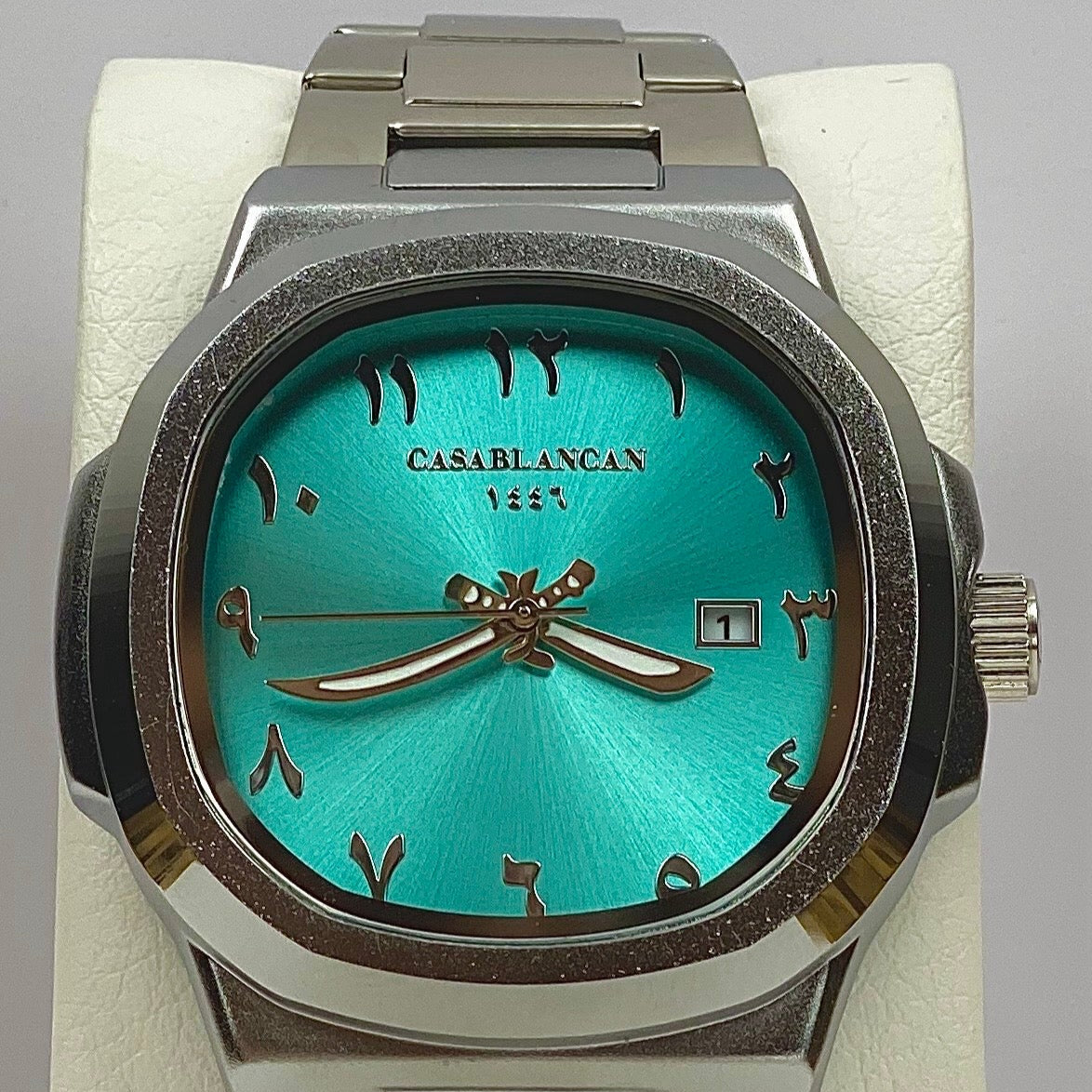
Casablancan's Al Majaz puts the Khanjar on a watch through hour and minute hands shaped like the dagger, set over Eastern Arabic numerals at every hour. The Al Majaz pairs those hands with a turquoise sunray dial. Casablancan builds the same dial in green, black, brown or turquoise, so the Khanjar hands and the numerals stay constant while the color changes.
Eastern Arabic numerals on the Al Majaz mark all twelve hours, not just a few chosen positions. Reading clockwise from the top, the figures run ١٢, ١, ٢, ٣ and onward through ١١. The two-digit hours are built the way Western numbers are, so ١٠ joins the figure for one with ٠, the zero. Once you see that pattern, ١١ and ١٢ make sense right away.
Eastern Arabic numerals have a few shapes that can trip up a new reader. The figure ٥ is five, though its rounded form can look like a Western zero. The figures ٧ and ٨ mirror each other: ٧ opens upward and means seven, while ٨ comes to a peak and means eight.
The Al Majaz dial is easiest to learn from four anchor points. Find ٣, ٦, ٩ and ١٢ first, since they sit at the quarter positions and frame the rest of the dial. Fill in the other eight hours from there. After a little practice, you read the time straight from the dagger tips without translating each figure.

The Al Majaz is our own watch, built on the Omani side of this comparison, with hour and minute hands shaped like the Khanjar dagger over a turquoise sunray dial. Its 43mm, 11mm-thick case is 304 stainless steel with sapphire crystal and a quartz movement, and the watch weighs 134g. The 304 stainless steel bracelet includes an adjustment tool. At 3 ATM, it handles handwashing, light rain and splashes, but not swimming or showering.
It is $89.
Frequently asked questions
What is the difference between an Omani Khanjar and a Yemeni jambiya?
The Omani Khanjar bends sharply, and its sheath turns upward almost at a right angle. The Yemeni jambiya usually follows a wider, gentler sweep with a broader, fuller blade and a rounded hilt.
Why is the Khanjar linked to Oman?
The Khanjar appears on Oman's national flag. That national symbol is one reason a Khanjar dial pairs naturally with Gulf dress such as a thobe or kandura.
Which dagger-shaped watch hand is easier to read at a quick glance?
A khanjar-style hand is easier to read in quick glances. Most of its length runs fairly straight before a clear hook near the tip, so the hand points cleanly at an hour marker.
Does a sunray dial work well with dagger-shaped hands?
A sunray dial makes the contrast between the two dagger shapes easier to see.
How do you choose a dial color for a dagger-hand watch?
The simplest rule for dial color is to match it to one other thing you wear, such as a belt, shoes or a pocket square. One echo is enough, since matching several pieces makes an outfit look staged.
Casablancan makes the Al Majaz mentioned in this article.
Read more
Notebookcheck reported on 2026-11-15 that Seiko has a new watch for the 2027 Year of the Sheep, part of its Year Watch Collection. Made in Japan, the watch has a fleece-textured, off-white dial wit...
Hamilton's Khaki Pilot GMT Air Zermatt, reference H76505930, is a 42mm forged carbon watch marking 15 years of Hamilton's partnership with Air Zermatt. It is the first Hamilton Pilot model with the...