
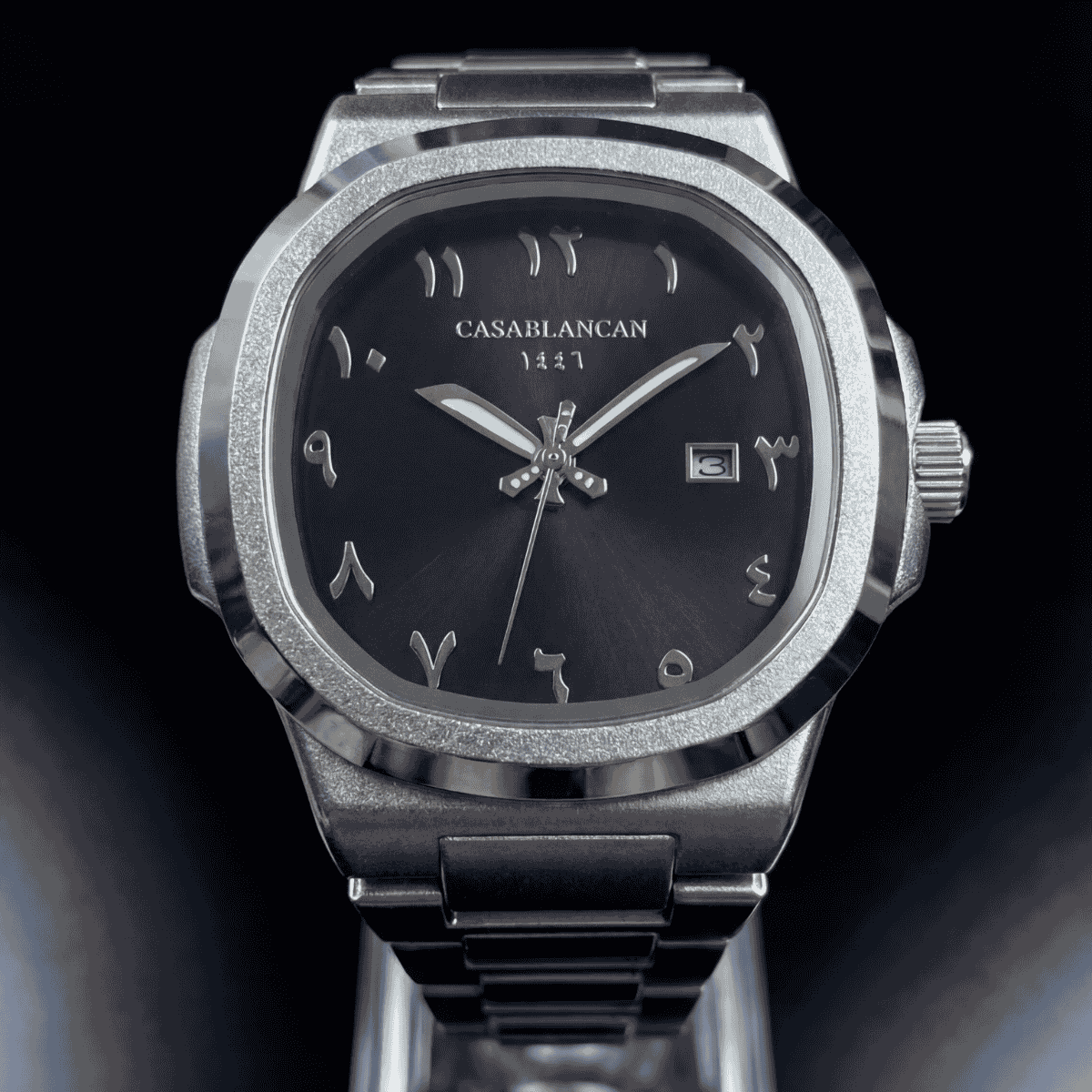
How to tell the time in Arabic by reading a watch dial
Quick answer: To tell the time in Arabic with a watch, match the hour hand to an Eastern Arabic numeral, then multiply the minute hand's digit by five. The numeral ١٢ still sits at the top. Read the last digit the hour hand has passed; a short hand past ٤ with the long hand on ٦ means half past four.
Telling the time in Arabic with a watch starts with the dial, not the words. If the hours are marked in Eastern Arabic numerals, reading the time comes down to learning those digit shapes, so the hands and the numbers make sense together. Once you know that ٣ means 3 and ٩ means 9, a glance at the hour hand tells you the hour.
A few minutes with this guide will let you read every hour on an Eastern Arabic dial, from ١ near the top right to ١٢ at the top. You will learn the two shapes that trip people up, including ٥, which looks like a Latin zero. You will also be able to decide whether an Arabic numeral dial is one you could read at a glance every day.
Key facts
- To read an Arabic dial, match the hour hand to an Eastern Arabic numeral, then count minutes on the same digits.
- The dial keeps the familiar twelve positions with ١٢ at the top, and the hands still turn clockwise.
- Each Eastern Arabic digit stands for five minutes, so multiply the digit under the minute hand by five.
- The zero ٠ is a small dot, while ٥, meaning five, is a small loop often mistaken for zero.
- The digit ٧ opens upward like a V, while ٨ is the same shape flipped, pointing up like a roof.
- For the hour, read the last digit the short hand has passed, not the one it is approaching.
How do you tell the time in Arabic with a watch?
Telling the time in Arabic with a watch means matching the hour hand to an Eastern Arabic numeral, then counting the minute hand across those same digits. The dial keeps the twelve positions you already know, with ١٢ at the top. Arabic script runs right to left, yet the hands still move clockwise. Only the digit shapes change, so the skill is recognition rather than a new system.
Eastern Arabic numerals on the dial also count the minutes, with each digit standing for five. A minute hand resting on ٥ means five past the hour. The shapes you write are the same ones printed around the dial.
What do the Eastern Arabic numerals from ١ to ١٢ look like?
Eastern Arabic numerals give each value from 1 to 9 its own shape, and the dial's ١٠, ١١ and ١٢ are built from those same digits plus ٠, the zero. The system is positional, exactly like the digits you already write. Learning nine shapes and a zero is enough to cover every hour on the dial.
| Eastern Arabic | Western | How to spot it |
|---|---|---|
| ٠ | 0 | A small dot, not a circle |
| ١ | 1 | One upright stroke, like a Western 1 |
| ٢ | 2 | An upright stroke with one hook at the top |
| ٣ | 3 | An upright stroke with two hooks at the top |
| ٤ | 4 | Looks like a backward 3 |
| ٥ | 5 | A small circle, the one people mistake for zero |
| ٦ | 6 | A short top stroke and a straight drop, close to a 7 |
| ٧ | 7 | A V that opens upward |
| ٨ | 8 | An upside-down V |
| ٩ | 9 | Close to a Western 9 |
| ١٠ ١١ ١٢ | 10 11 12 | Two digits, read left to right like Western numbers |
The first five Eastern Arabic digits are the gentlest place to begin. ١ is a single upright stroke, close to the 1 you already know. ٢ adds a small hook at the top right, and ٣ carries two small hooks along its top edge. ٤ curls back on itself, a little like a backward 3, while ٥ is a small rounded loop.

The Eastern Arabic digits from ٦ to ٩ complete the set and fill the lower and left side of the dial. ٦ resembles a Latin 7 seen in a mirror, and ٩ looks much like the Latin 9. ٧ opens upward like a V, and ٨ is that same shape turned upside down, with its point at the top like a roof. On the dial, ٦ sits at the bottom and ٩ marks the left side, right where 6 and 9 normally appear.
The two-digit hours, ١٠, ١١ and ١٢, are where the zero earns its place. ٠ is written as a small dot, so ١٠ reads as an upright stroke followed by that dot. ٢ is two upright strokes side by side, and ١٢ pairs one stroke with the hooked ٢. Arabic text runs right to left, yet these numbers keep the tens digit on the left, just as 10, 11 and 12 do.
Which Eastern Arabic numerals are easiest to confuse?
The Eastern Arabic numerals most often confused are ٥, which resembles a Latin zero, and the pair ٧ and ٨, which share one shape turned two ways. Both mix-ups grow out of habits formed by reading Latin digits. A few simple visual cues settle each one.
If you spot a loop by itself, read five.
٨ flips that cup over so the point rises like a roof peak. A simple prompt helps: seven holds water, eight sheds rain.
Dial position gives you a second check when the shapes blur at a glance. On a twelve-hour face, ٧ sits at the lower left, and ٨ sits just above it, closer to ٩. A V near the bottom is seven, and a roof shape higher up is eight.
How do the hands and the numerals work together on an Arabic dial?
The digits change shape, but the twelve positions and the direction of travel stay the same.
When the long hand rests on ١, read five minutes past. On ٣ it is fifteen, on ٦ thirty, and on ٩ forty-five. Multiply the digit by five to get the minutes, so ٨ gives forty, ١١ gives fifty-five, and ١٢ marks the exact hour.
The hour hand needs one extra habit, because the short hand rarely sits squarely on a numeral. Read the last digit the short hand has passed, not the one ahead of it. A short hand halfway between ٤ and ٥, with the long hand on ٦, means half past four. Near the top of the hour, the short hand almost touches the next digit, so check the long hand before you decide.
A quick drill ties the two hands together into a single reading. Say each reading aloud in whichever language you prefer until the shapes and positions register together.
Practicing Arabic numerals on a dial with Khanjar hands
A watch dial with an Eastern Arabic numeral at every hour and Khanjar dagger hands turns each glance at your wrist into a short reading drill. A dial like this shows all twelve digits from ١ to ١٢, so no position is left blank for your memory to fill in. Every time check repeats the same shapes in the same places.
Khanjar hands help because the dagger shape ends in a clear, pointed tip. The shorter dagger marks the hour and the longer one counts minutes, so the two never blur together. A sunray finish, with fine lines radiating from the center, catches light from different angles behind the numerals.
The dial described here comes in a green, black, brown or turquoise sunray, inside a 43mm, 11mm-thick case of 304 stainless steel with sapphire crystal. A quartz movement keeps the hands running without winding, so the watch is ready whenever you look. The 3 ATM rating covers handwashing, light rain and splashes, though not swimming or showering.
A one-week habit makes the digits stick faster than a chart. Every time you check the watch, name the Eastern Arabic hour digit aloud first, then the minute digit, then the full time. By the end of the week, try reading the dial before you think in Latin numbers at all.

The Onyx Sentinel is our own Casablancan watch, and it suits the method in this guide. A 43mm, 11mm-thick 304 stainless steel case holds a quartz movement under sapphire crystal. Casablancan offers free worldwide shipping, with delivery in 7-15 business days.
It is $89.
Frequently asked questions
Do the hands on an Arabic numeral watch move counterclockwise?
The hands on an Eastern Arabic numeral dial still move clockwise, even though Arabic script runs right to left. The dial keeps the same twelve positions, with ١٢ at the top. Only the digit shapes change.
Which Eastern Arabic numeral looks like a zero?
The Eastern Arabic numeral ٥ means five, even though its small rounded loop looks like a Latin zero. The real Eastern Arabic zero, ٠, is written as a small dot. A loop on its own should be read as five.
How do you read the minutes on an Eastern Arabic dial?
Minutes on an Eastern Arabic dial are read by multiplying the digit under the minute hand by five. A minute hand on ٣ means fifteen minutes, on ٨ forty, and on ١١ fifty-five. A minute hand on ١٢ marks the exact hour.
How can you tell the Arabic numerals ٧ and ٨ apart?
The Arabic numeral ٧ opens upward like a V, while ٨ is the same shape flipped, with its point on top like a roof. A handy prompt is that seven holds water and eight sheds rain. On a dial, ٧ sits at the lower left and ٨ sits just above it.
How long does it take to learn to read an Arabic numeral watch?
Reading every hour on an Eastern Arabic numeral watch can take only a few minutes of study. A one-week habit helps the digits stick. Each time you check the watch, name the hour digit aloud, then the minute digit, then the full time.
Casablancan makes the Onyx Sentinel mentioned in this article.
Read more
Oris has added an oxblood red dial to its Big Crown Pointer Date, Monochrome reported on 2026-11-03. The reference 01 754 7798 4038-07 8 20 06 joins the permanent collection, retails for CHF 2,000 ...
Louis Vuitton added the Tambour Convergence Mirror Steel (reference W9ST11) to its Tambour Convergence collection, as Hodinkee reported. The 37mm watch uses hardened stainless steel with a mirror p...